10 hr
Delphi Archaeology & Arachova Village Day Trip from Athens
- Expert local guide
- Small group
- Skip-the-line access
- Free cancellation
Day Trip to Delphi from Athens — Ancient Oracle & Mountain Sanctuary
Where mortals sought prophecy beneath Parnassus, carved ruins meet open sky.
Compare fares, pick the fit — all bookings are mobile-voucher and eligible for free cancellation where shown.
10 hr
10 hr
11 hr
| Experience | From | Duration | Rating | Skip-the-line | Guide | Small group | Price | |
|---|---|---|---|---|---|---|---|---|
|
Guided Experience
Most popular
Delphi Archaeology & Arachova Village Day Trip from Athens
|
Athens | 10 hr | ★ 4.6 | ✓ | ✓ | ✓ | €26 | Book → |
|
Guided Experience
Delphi Day Trip with VR Audio Guide from Athens
|
Athens | 10 hr | ★ 4.5 | ✓ | ✓ | ✓ | €26 | Book → |
|
Guided Experience
Delphi Oracle & Museum Day Trip from Athens
|
Athens | 11 hr | ★ 4.8 | ✓ | ✓ | ✓ | €35 | Book → |
Worth it for history seekers and archaeological enthusiasts
A day trip to Delphi from Athens delivers substantial value at 12 EUR for combined site and museum access, though the round-trip transit consumes four to five hours. You're paying for one of Greece's most significant archaeological complexes: the Temple of Apollo where the Oracle once prophesied, a 5,000-seat ancient theatre with sweeping mountain views, a hillside stadium, and a museum housing the Charioteer of Delphi bronze and sphinx sculptures. The site sprawls across terraced slopes below Mount Parnassus, requiring moderate fitness for the uphill walk. Tour groups flood the Temple of Apollo between 11:00–14:00, so independent travelers arriving at 08:30 gain quieter access and better photos. The 12 EUR entry represents strong value compared to Athens' major sites—you're covering both excavated ruins and a world-class museum. Day trip to Delphi from Athens tours typically bundle transport and guiding, raising costs to 90–110 EUR but eliminating logistics. For visitors prioritizing ancient Greek sanctuaries over beach resorts, Delphi justifies the travel time.
Bottom line: The combination of affordable day trip to Delphi from Athens tickets, UNESCO-caliber ruins, and the Oracle's historical weight makes this excursion worthwhile for anyone drawn to classical Greece beyond the Acropolis.
A day trip to Delphi from Athens covers the oracle site at a comfortable pace, while the combined Delphi and Meteora tour trades that breathing room for a second UNESCO landmark of clifftop monasteries; most travelers with only one day call the Delphi-only option the saner choice.
|
Top pick Delphi Day Trip |
Delphi + Meteora (1-2 Day) | |
|---|---|---|
| What you see | Archaeological site, Temple of Apollo, museum | Same Delphi sites plus Meteora's clifftop monasteries |
| Total travel time | About 5-6 hours round trip by road | 10-12+ hours round trip, often overnight |
| Typical duration | Full day (8-11 hours door to door) | 1 overnight or 2 full days |
| Pacing/fatigue | Moderate — one long coach ride each way | High — long drive plus early monastery starts |
| Best for | Travelers with one free day in Athens | Travelers wanting two UNESCO sites in one trip |
| Price range | 65-95 EUR per person | 150-250 EUR per person (with hotel) |
| See tickets & prices |
Hand-picked experiences loved by thousands of travelers
Full day (approximately 9 hours)
Free Cancellation
Discover ancient oracle secrets and mountain village charm on this guided escape to Greece's legendary sanctuary
11 hours
Free Cancellation
Journey to Greece's legendary oracle site with expert guidance through ancient temples, museums, and mountain villages
10 hours
Free Cancellation
Journey to the ancient oracle site with guided tour of Apollo's sanctuary and archaeological treasures
12 hours
Free Cancellation
Explore ancient oracle sites, legendary battlefields, and mountain caves on this immersive full-day journey
9 hours
Free Cancellation
Journey to the ancient Oracle's sanctuary with expert-guided exploration of temples, treasures, and myths
10 hours
Free Cancellation
Journey to the ancient Oracle's sanctuary, a UNESCO World Heritage Site at the heart of the Greek world
10 hours
Free Cancellation
Journey to legendary battlefields and ancient oracle sites on this comprehensive private tour
10 hours
Free Cancellation
Journey to Greece's ancient oracle site with audio guide, museum access, and a scenic mountain village stop
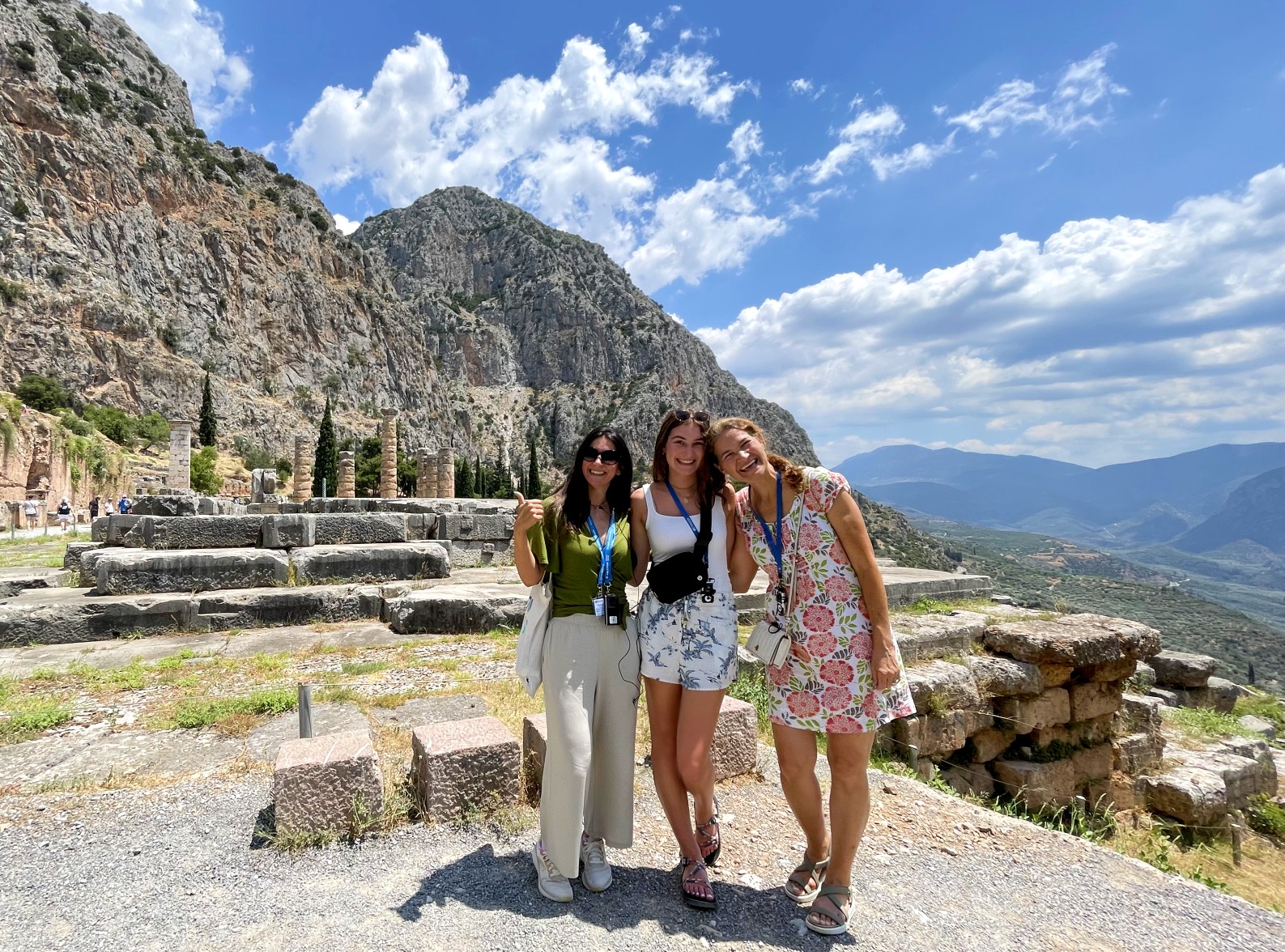
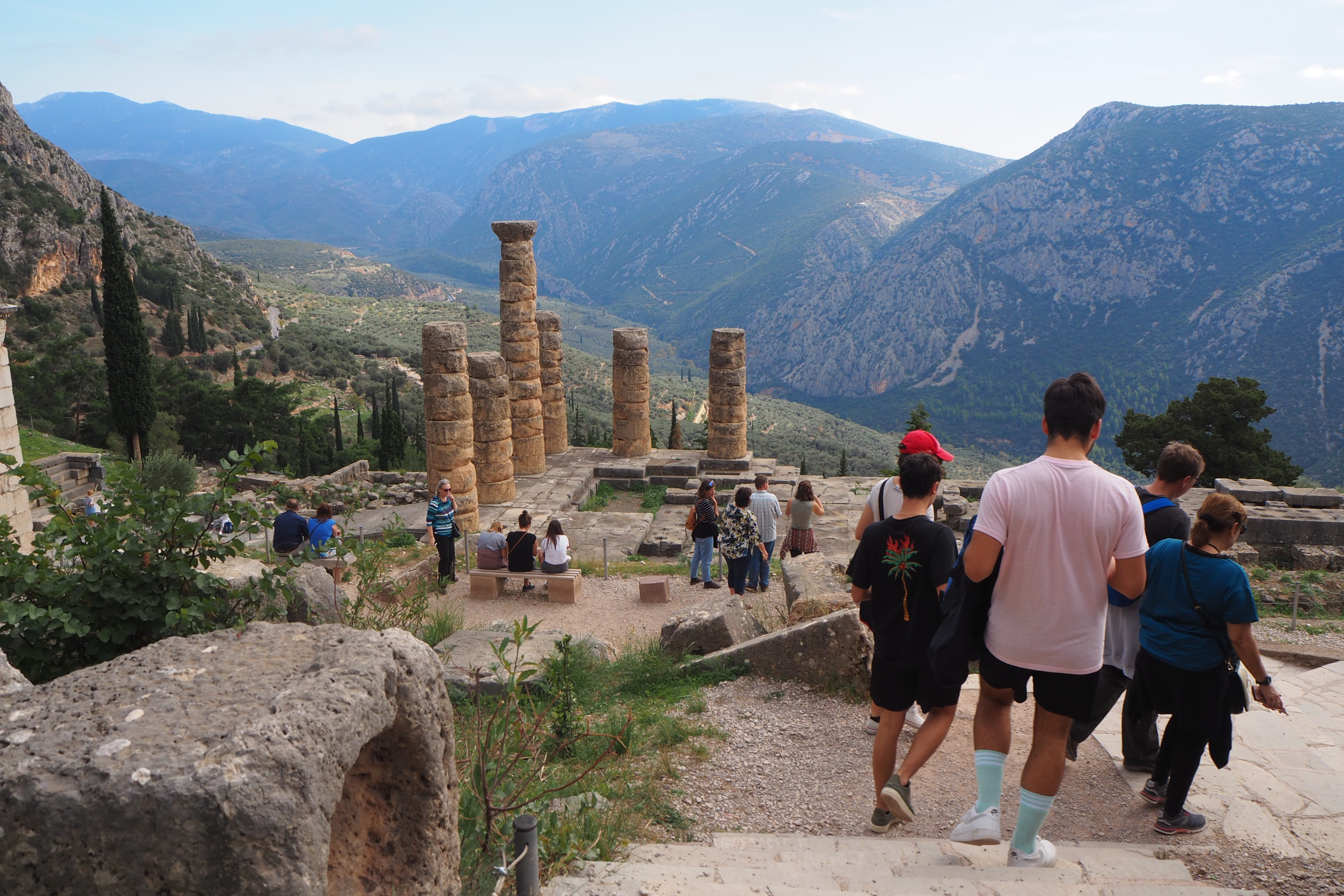
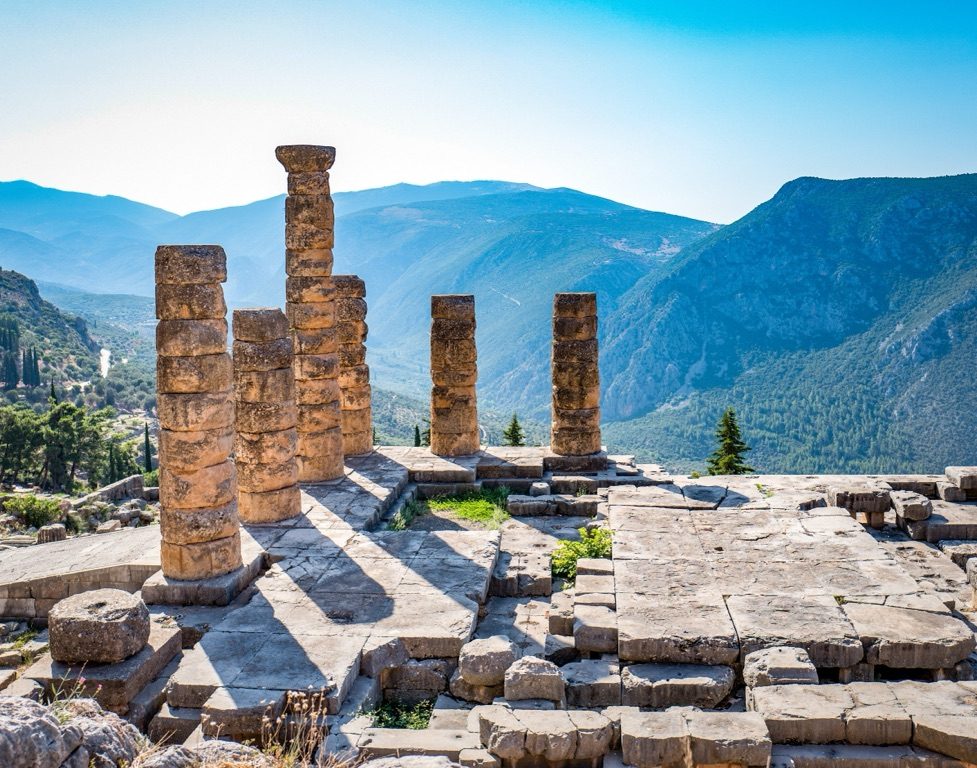
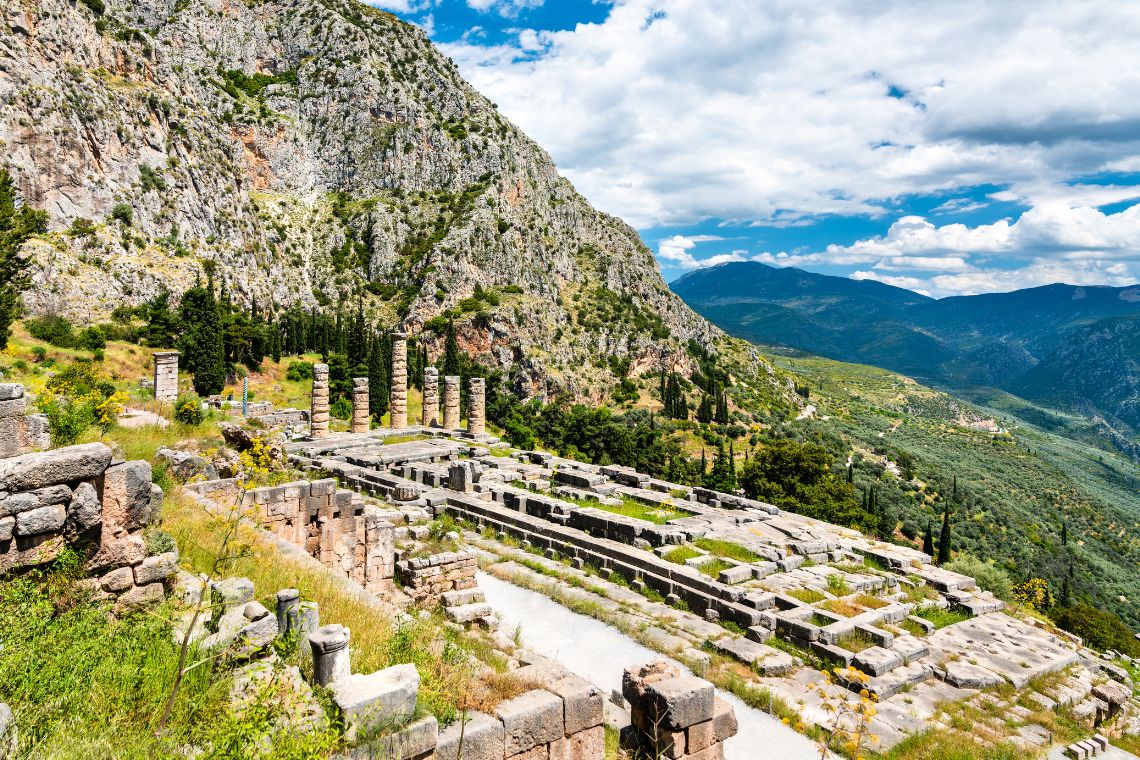
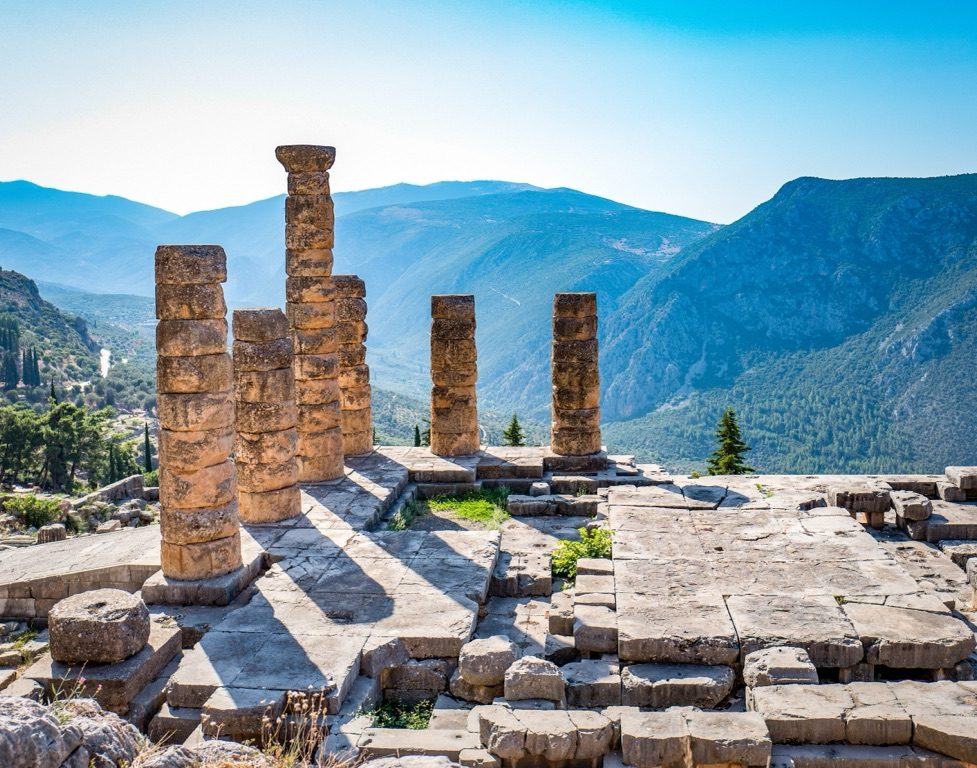
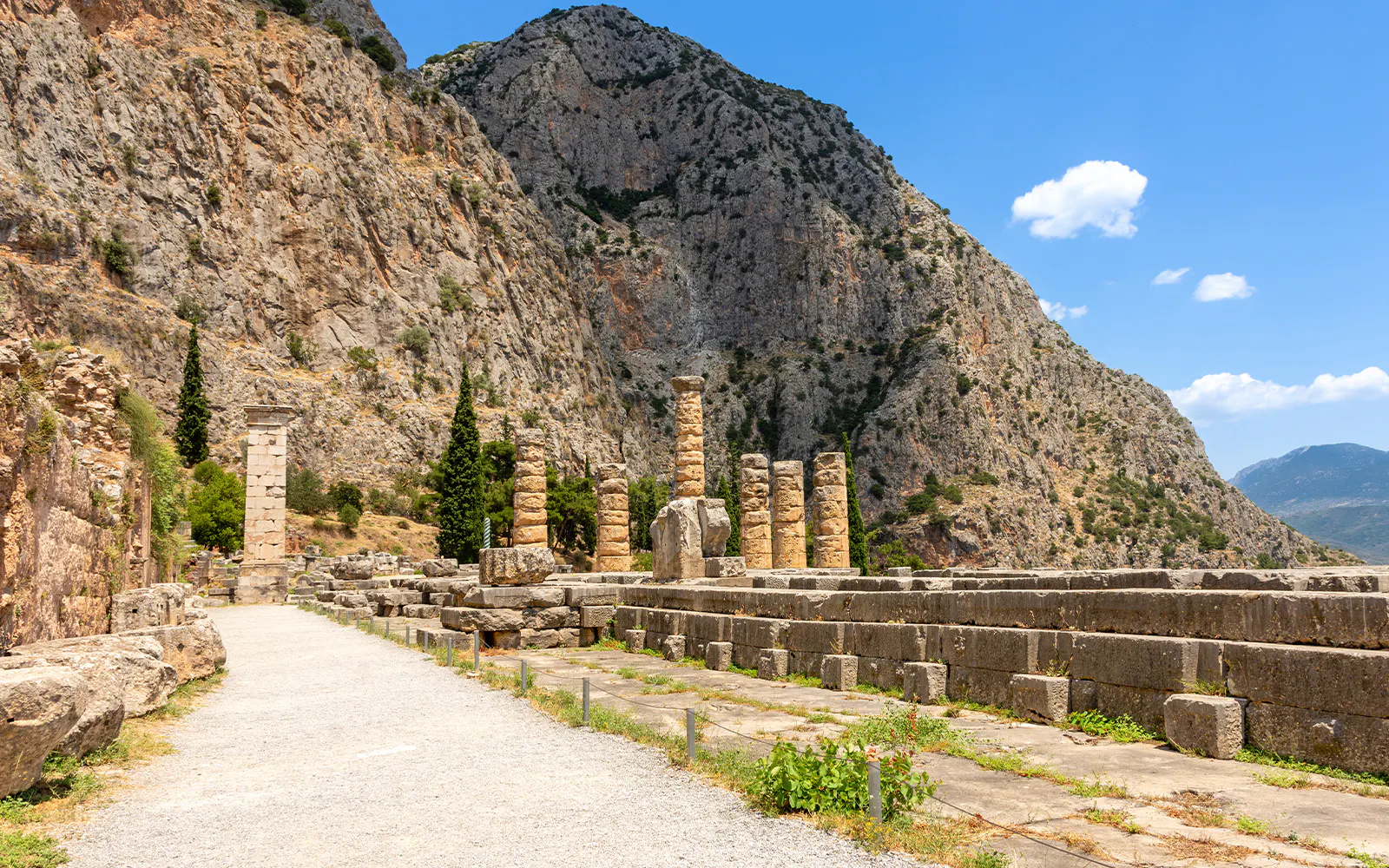
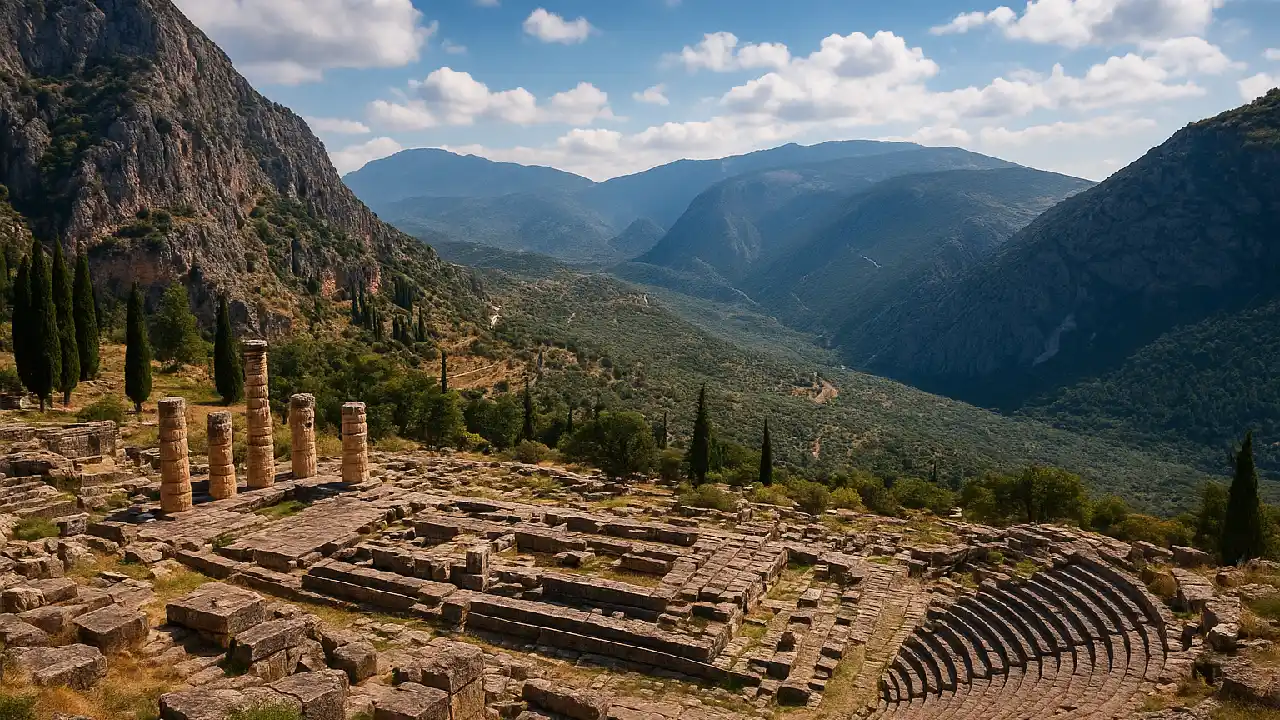
The partially reconstructed columns mark the spot where the Pythia, Delphi's oracle, delivered prophecies attributed to Apollo. Only six of the original 38 columns remain standing, dating mainly to a 4th-century BC rebuilding after an earlier temple burned down.
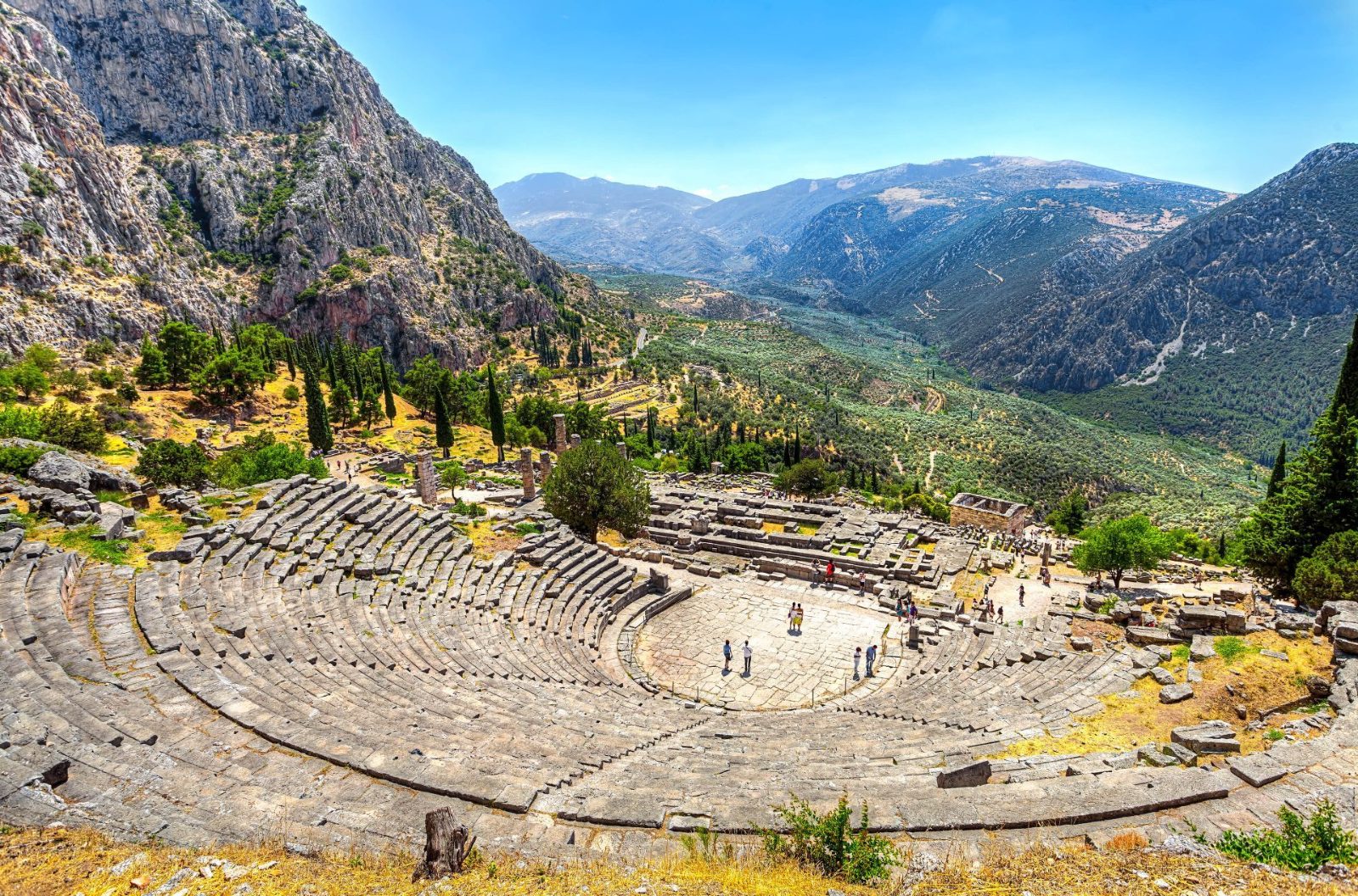
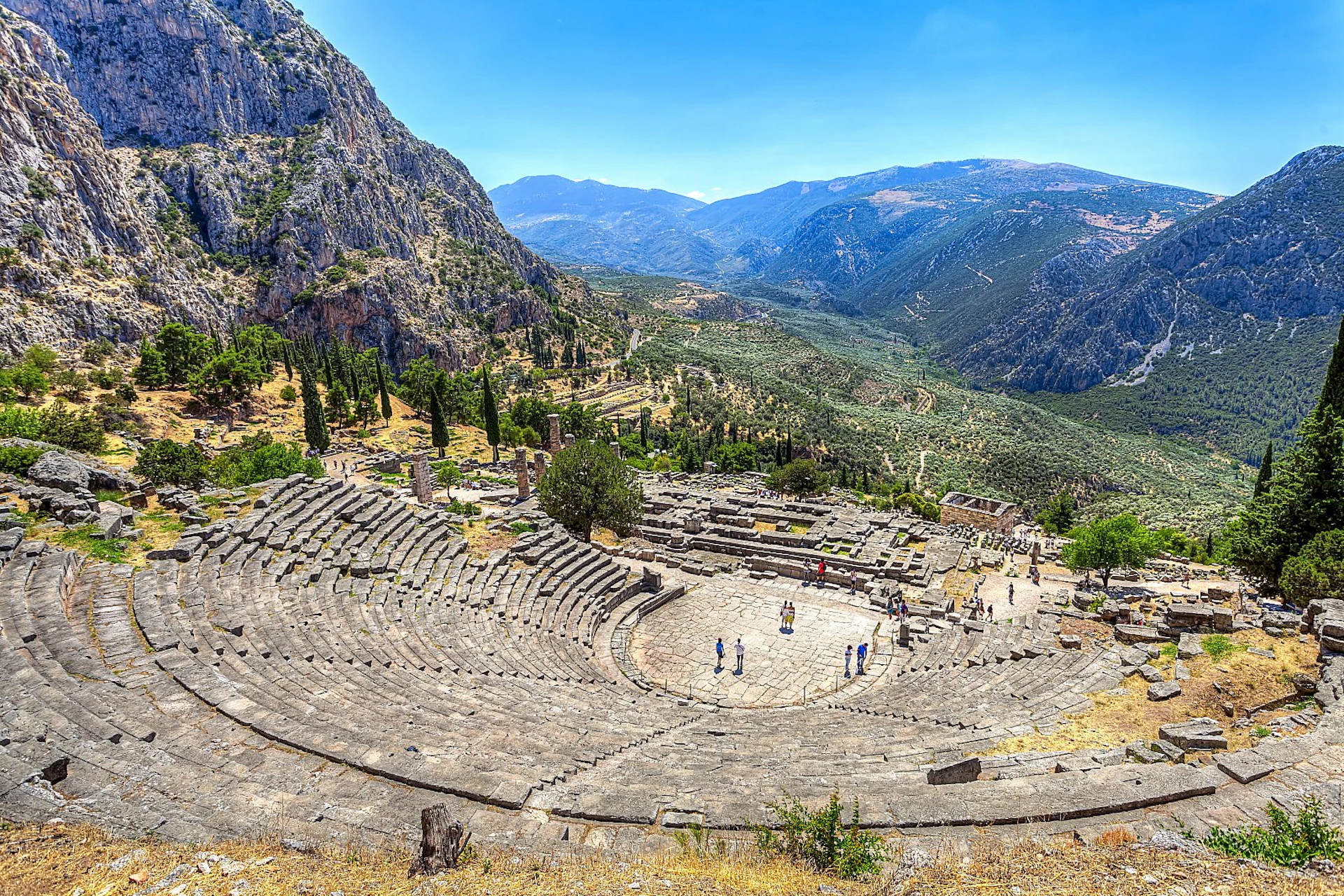
Carved into the hillside above the Temple of Apollo, the theatre seated around 5,000 spectators and was used for musical and dramatic contests during the Pythian Games. Its 35 rows of stone seating still frame a wide view over the Pleistos Valley.
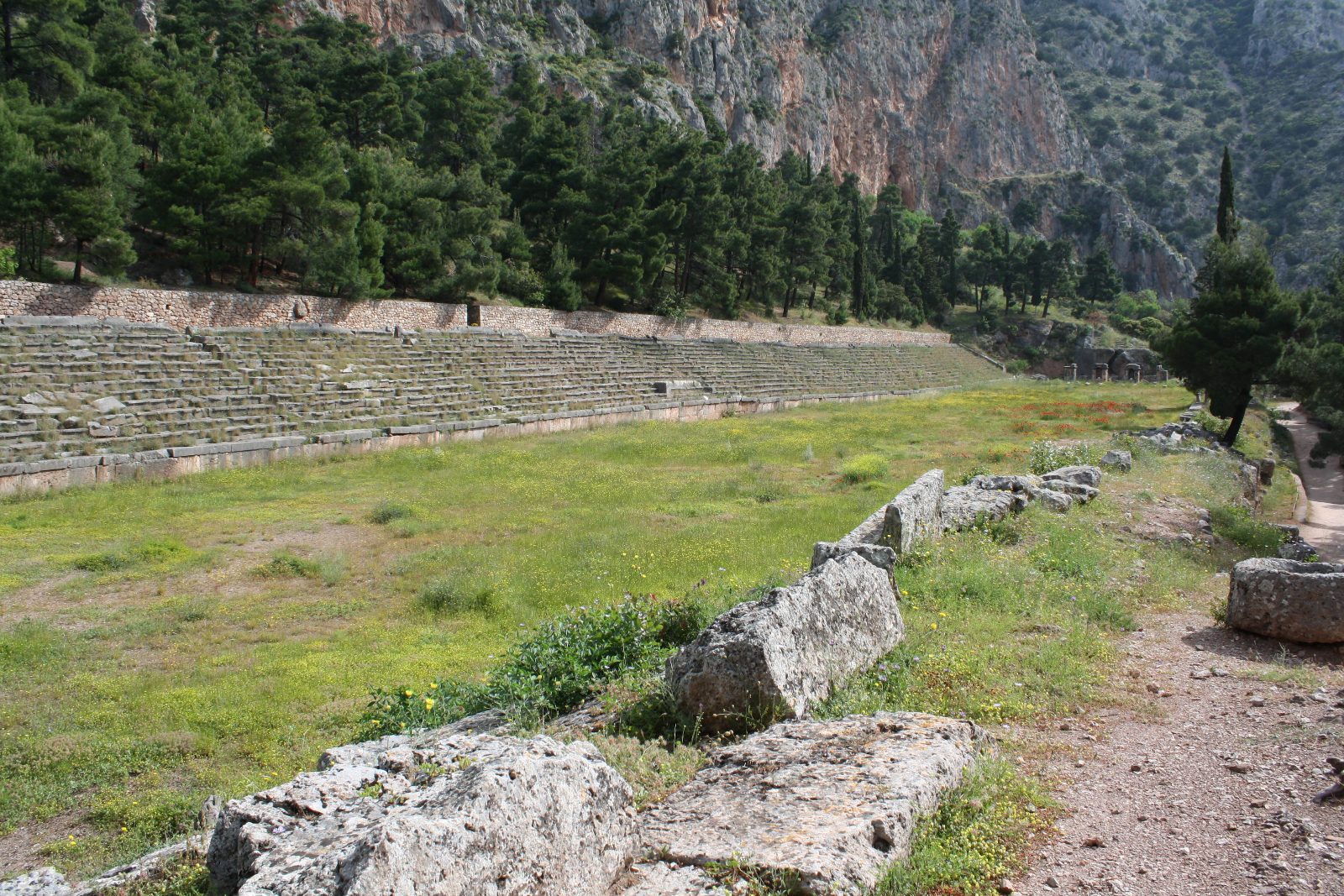
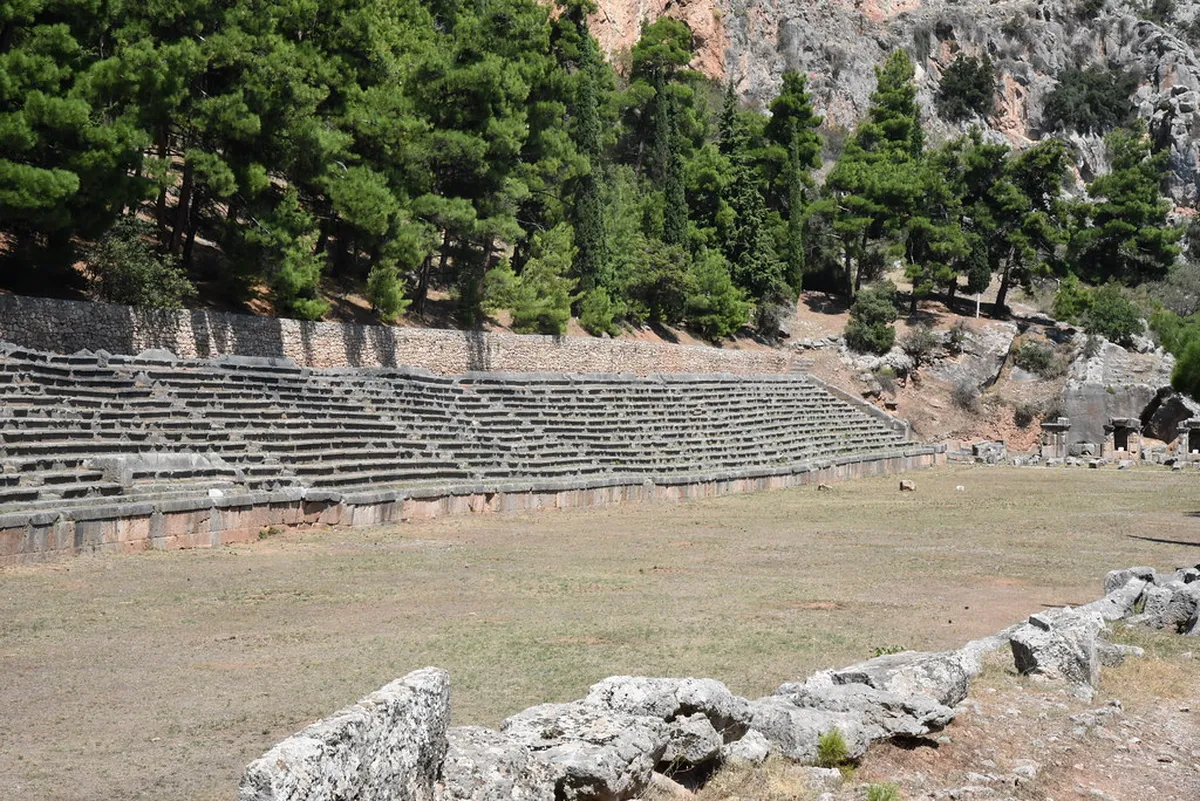
Set at the highest point of the site, this stone stadium hosted the athletic events of the Pythian Games every four years. It remains one of the best-preserved ancient stadiums in Greece, with much of its seating and starting line still intact.
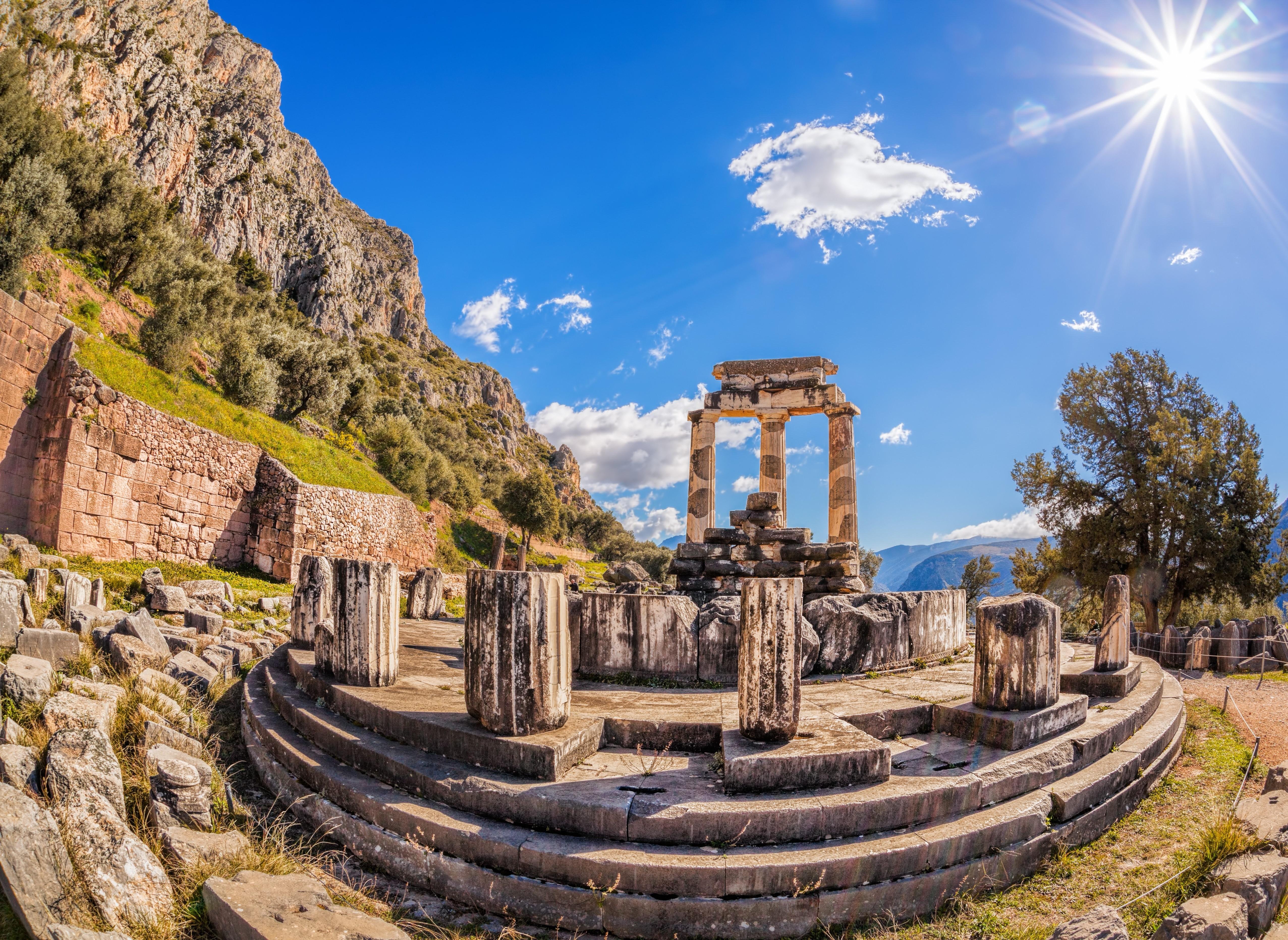
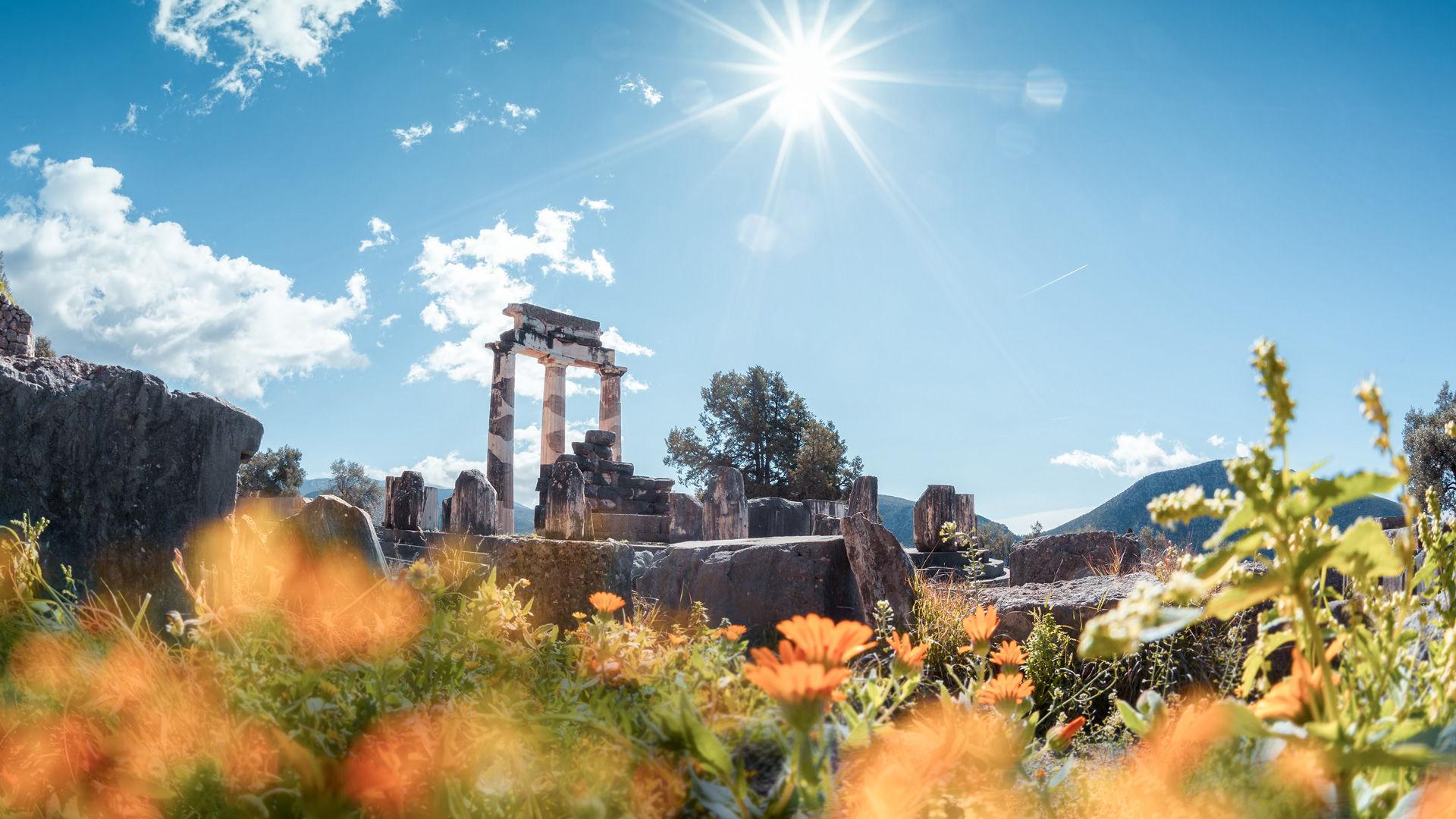
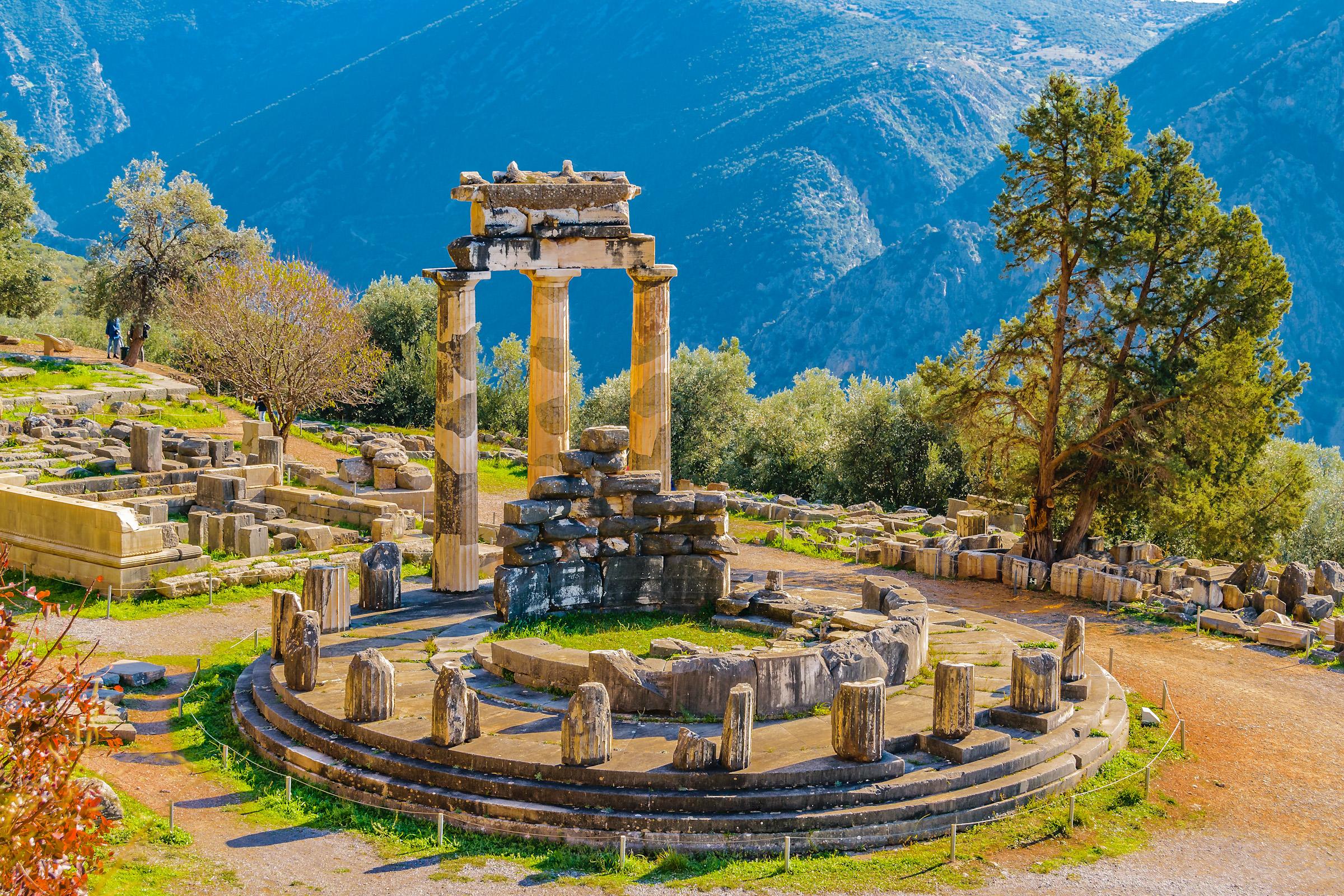
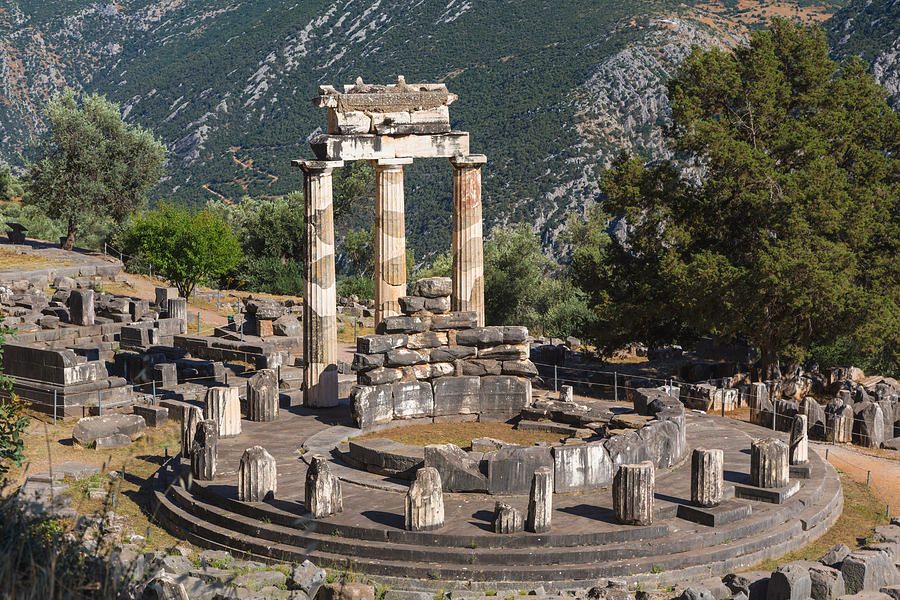
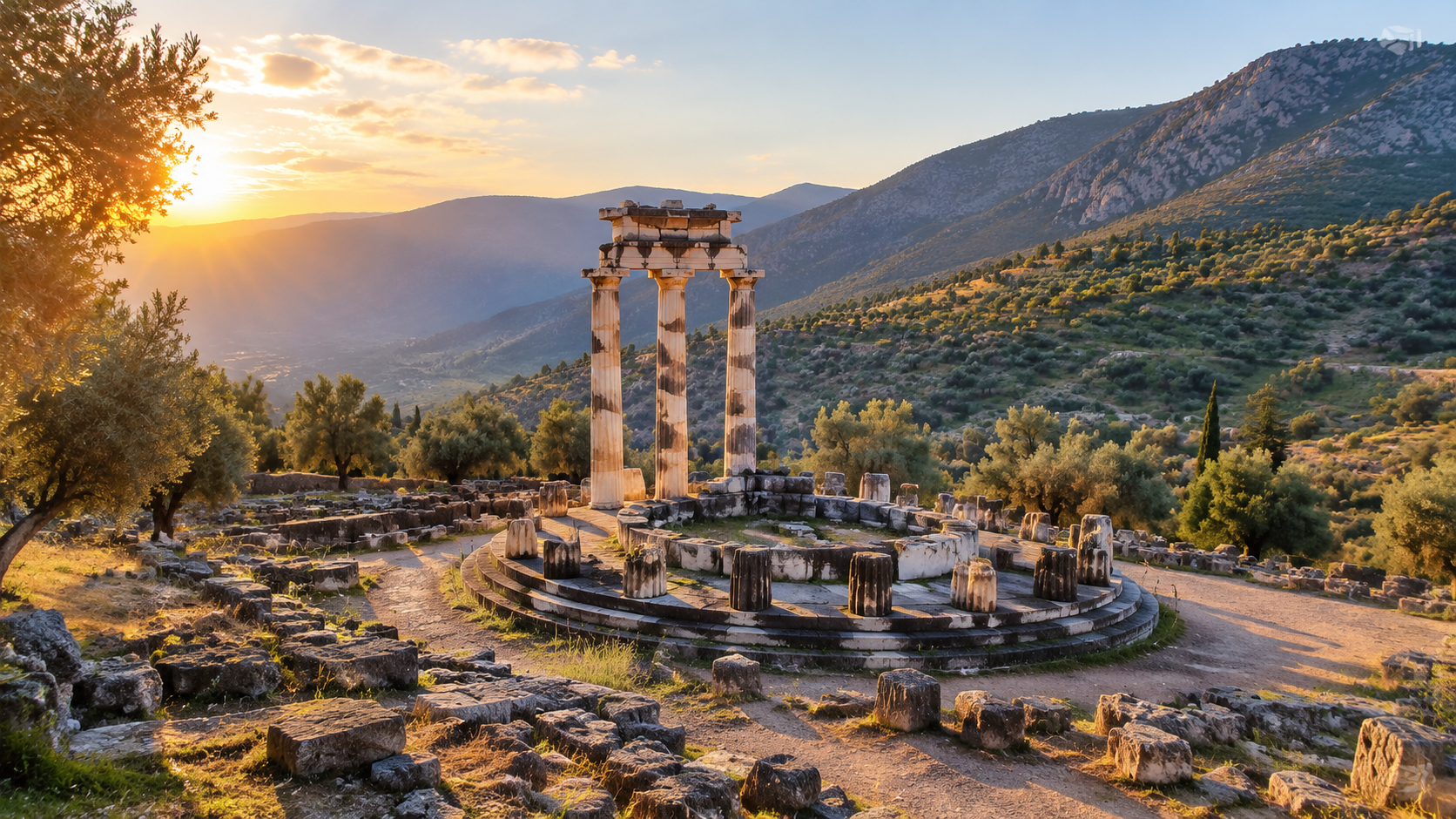
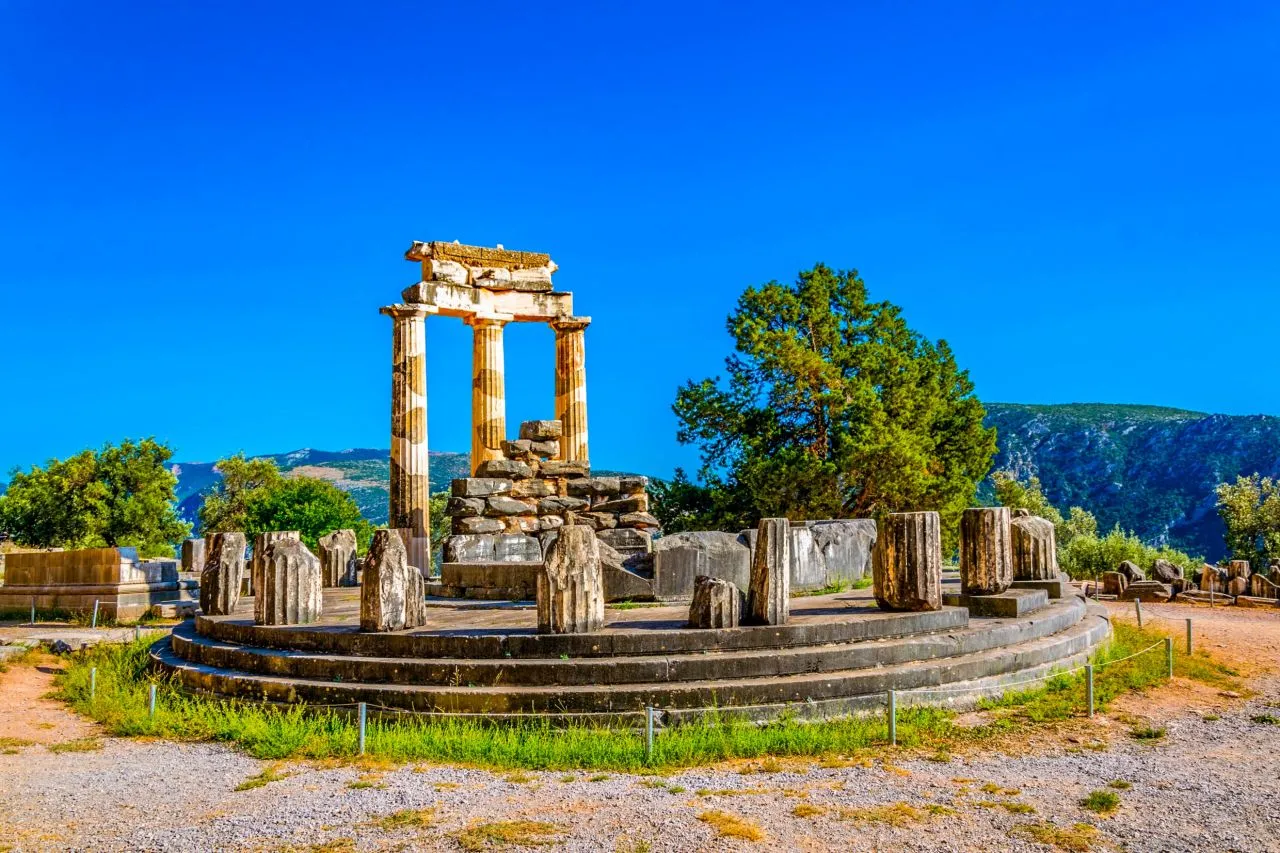
This circular structure of unknown exact purpose is one of the most photographed ruins in Delphi, with three of its original 20 Doric columns still standing. Built around 380–360 BC, its function remains debated among archaeologists.
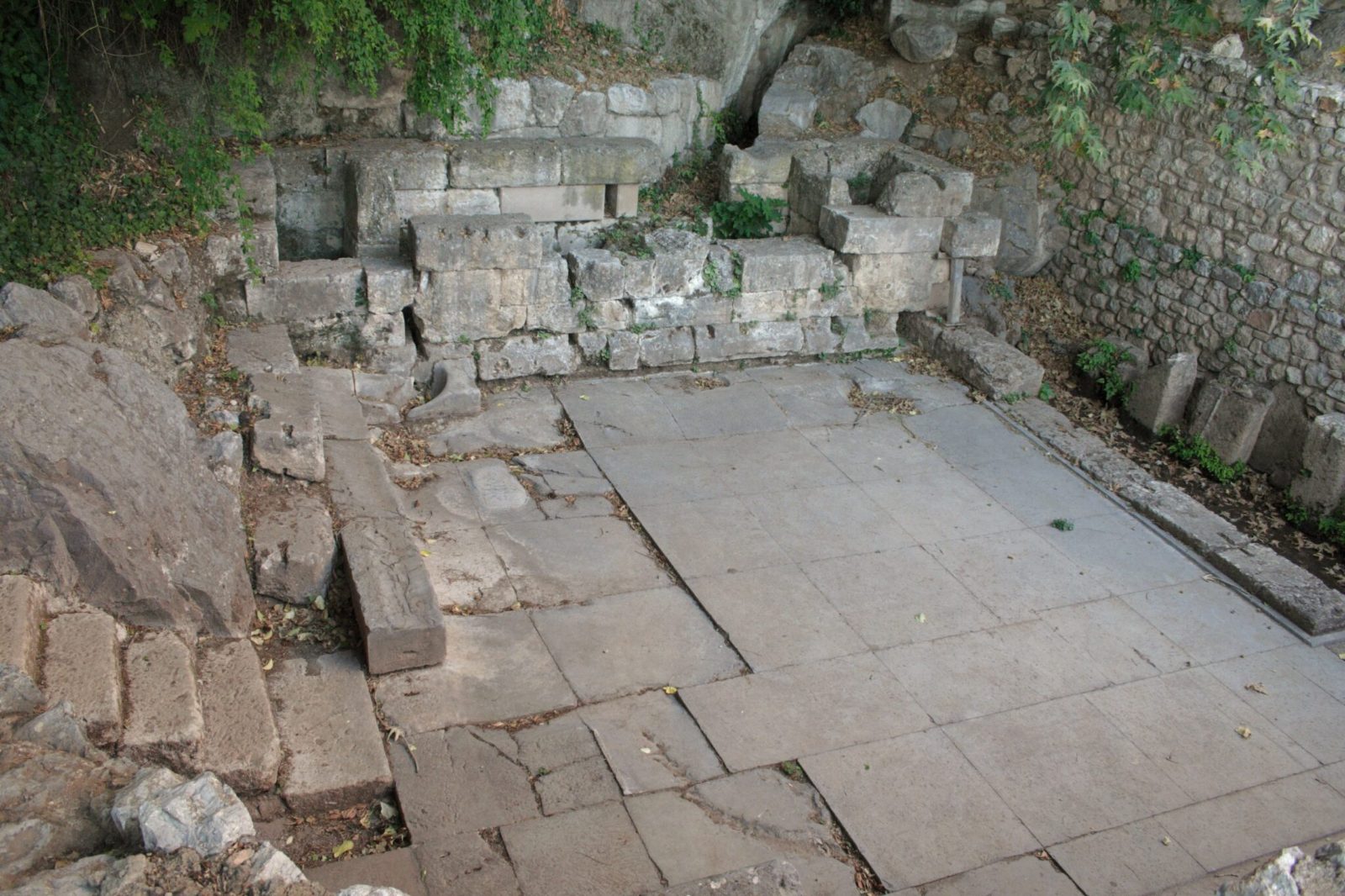
Ancient visitors and priestesses stopped here to purify themselves with spring water before entering the sanctuary to consult the oracle. The spring sits in a narrow gorge on the approach road, framed by carved niches cut into the rock face.
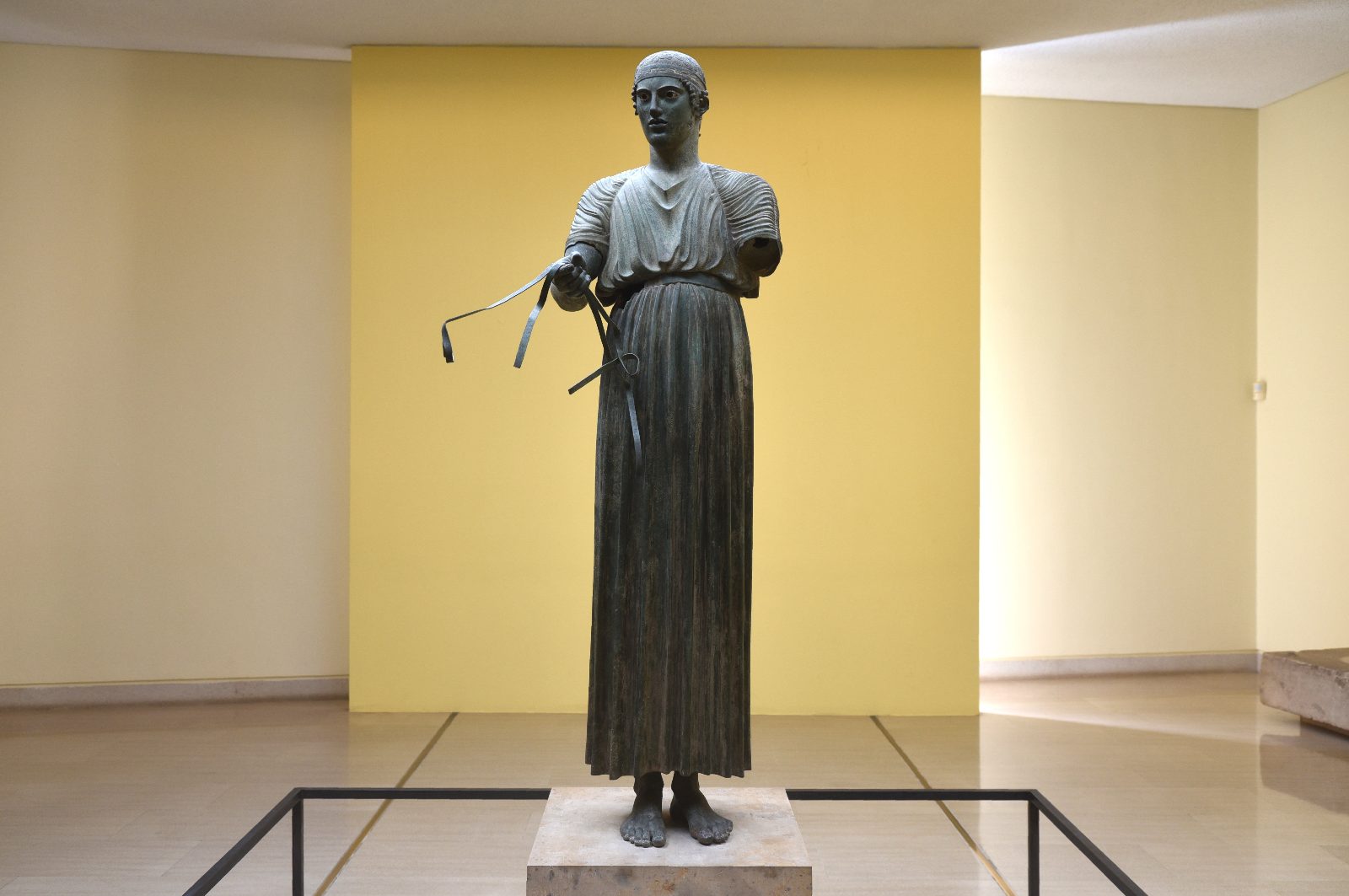
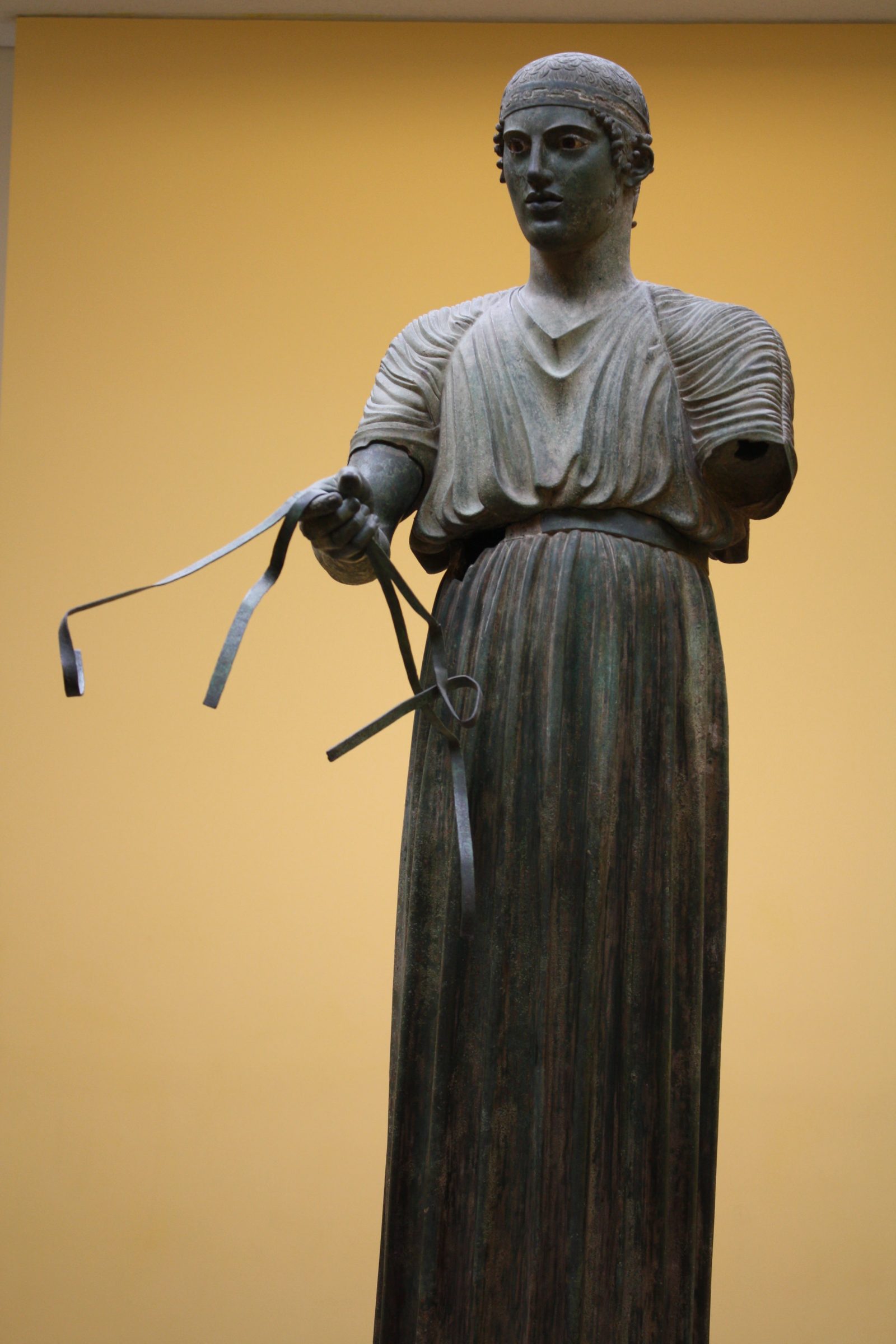
Housed in the Delphi Archaeological Museum, this life-size bronze statue from around 474 BC survived a rockslide that buried and preserved it for centuries. Its glass-paste eyes and detailed drapery make it one of the best-preserved bronzes from ancient Greece.
You leave Athens before sunrise, the highway cutting northwest through Boeotia as the sun lifts over the mountains. Two hours later, the road climbs into Parnassus foothills and delivers you to the lower parking area.
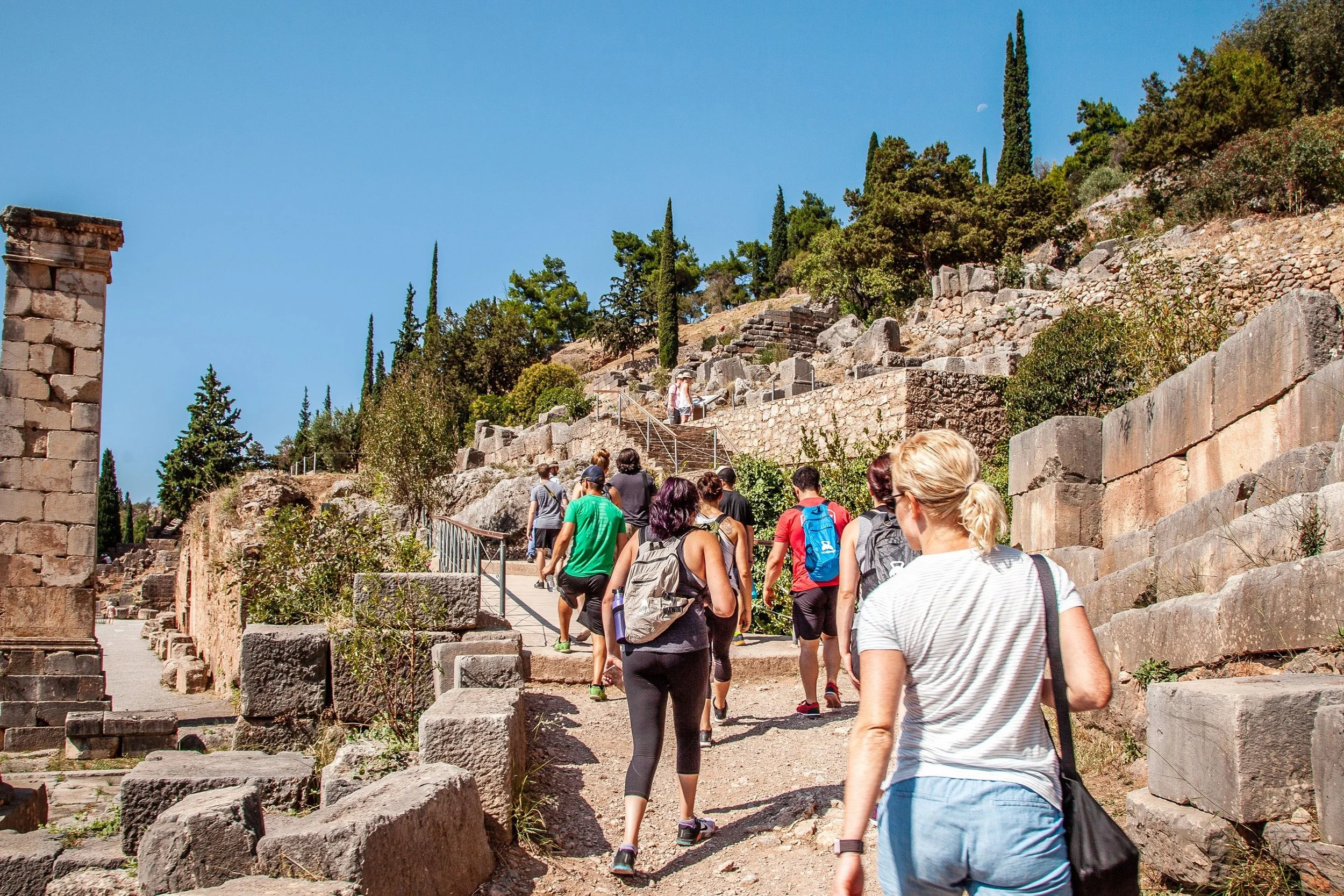
You walk uphill past the Castalian Spring, where pilgrims once purified themselves before approaching the Oracle.
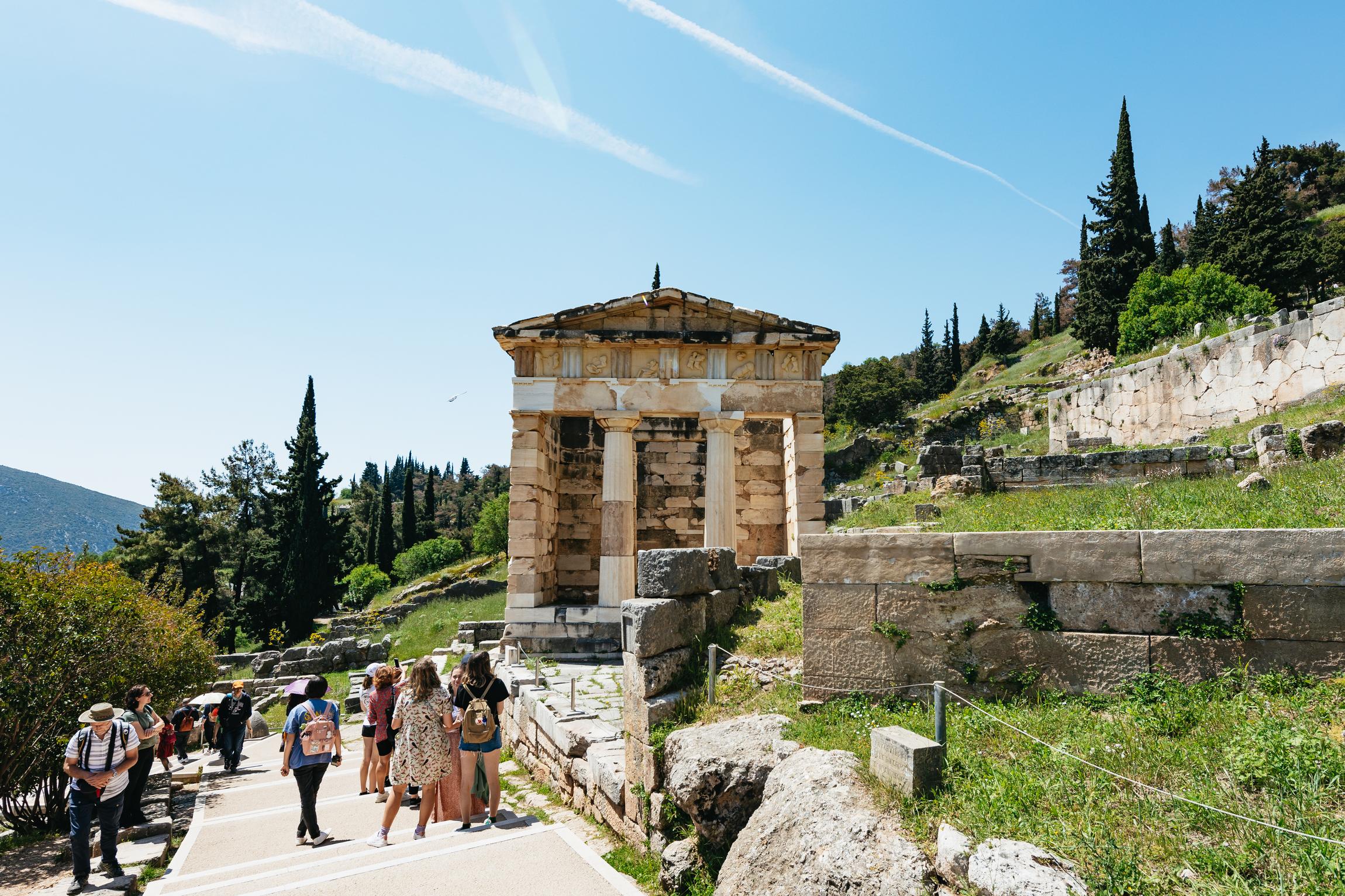
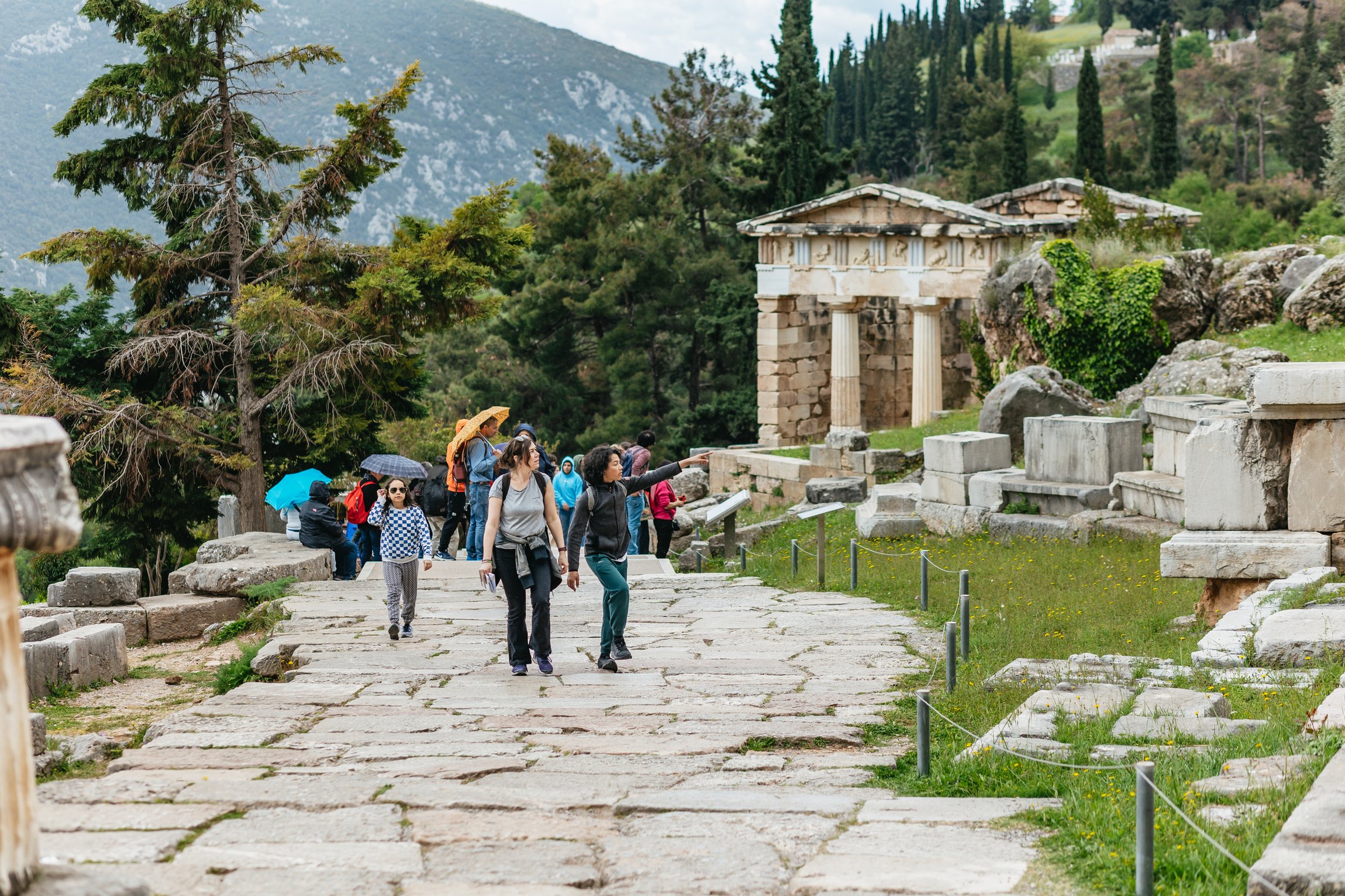
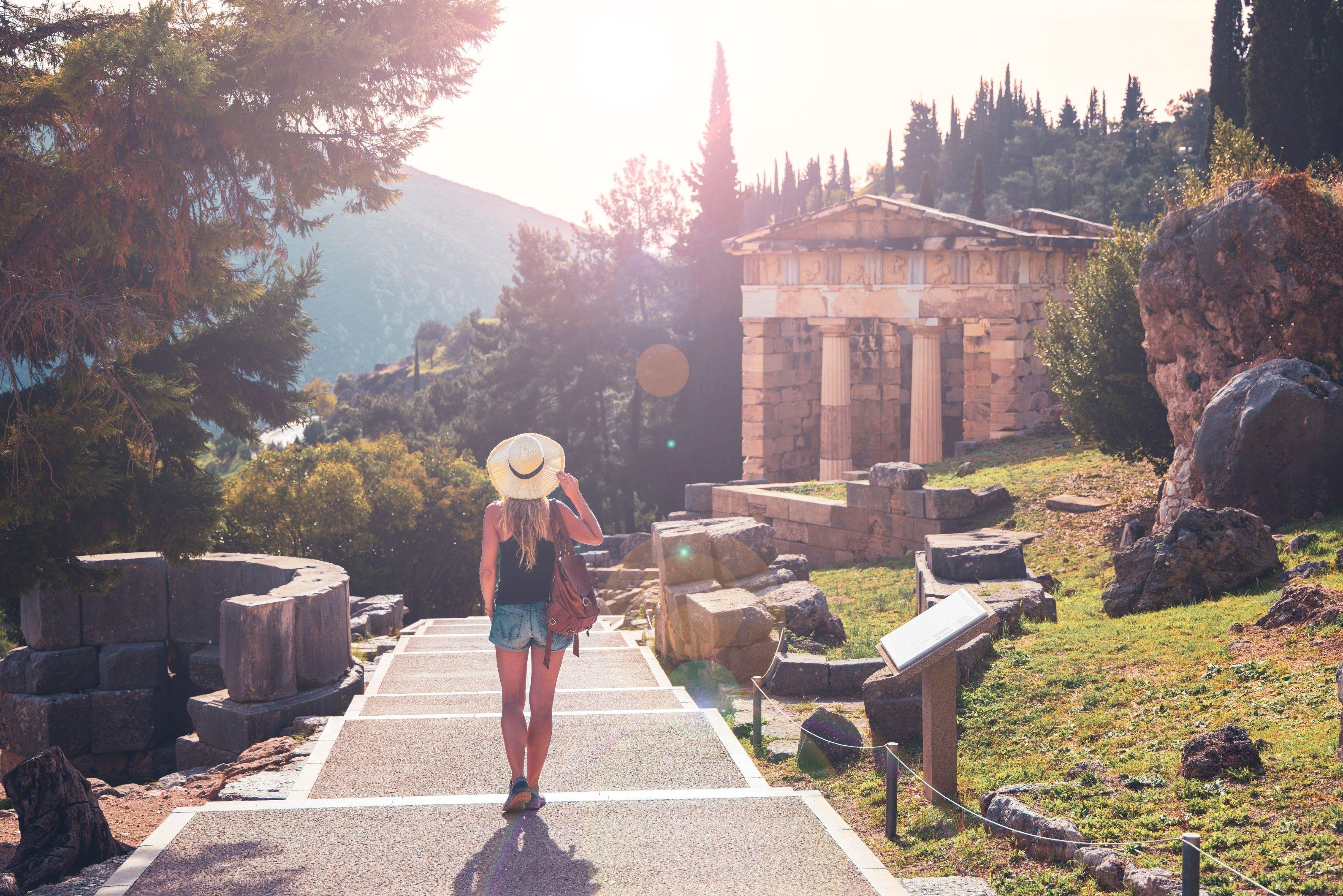
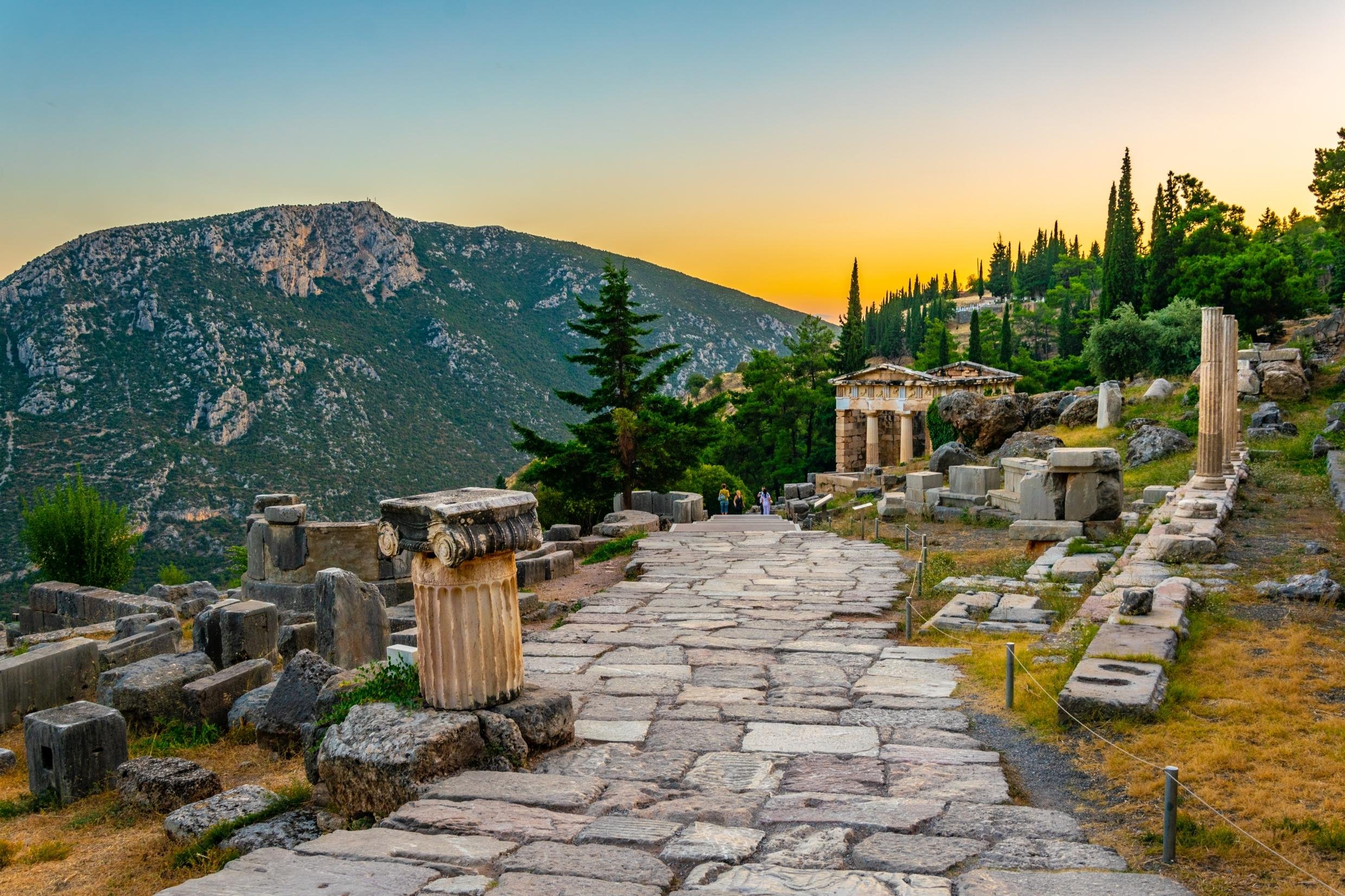
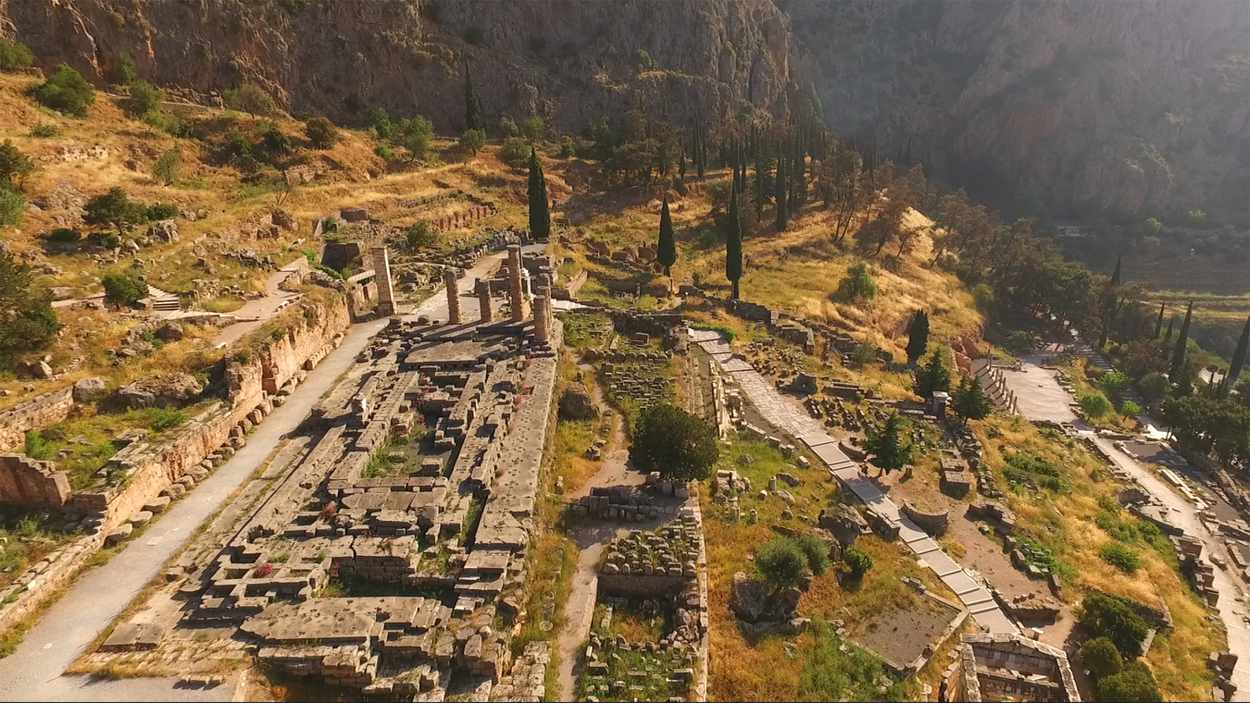
The Sacred Way zigzags through foundation walls of ancient treasuries. You pause at the reconstructed Treasury of the Athenians, its Doric columns supporting a marble pediment. Higher, the Temple of Apollo reveals six standing columns against open sky. You circle the platform, reading inscriptions carved into the stone. The theater tiers rise another 50 meters above — you climb to the top row and look down over the entire sanctuary, the valley falling away in terraced silver-green olive groves.
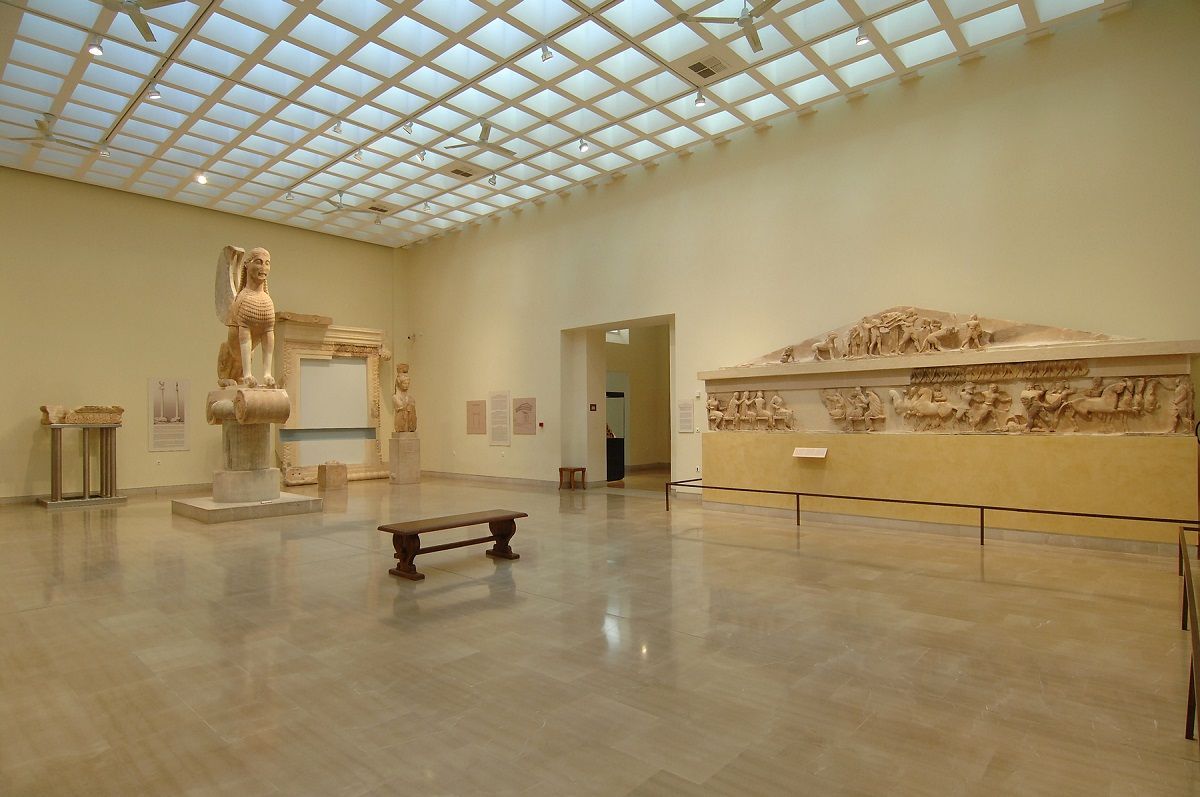
Inside the museum, you stand before the Charioteer — a bronze figure so precisely cast that individual eyelashes remain visible after 2,500 years. The galleries progress chronologically: archaic kouroi give way to classical friezes, then Hellenistic portraits and Roman copies. You exit into afternoon light, the combination of ruins and artifacts forming a complete picture of the site's thousand-year reign as the center of the Greek world.
All the details about your upcoming adventure in one place
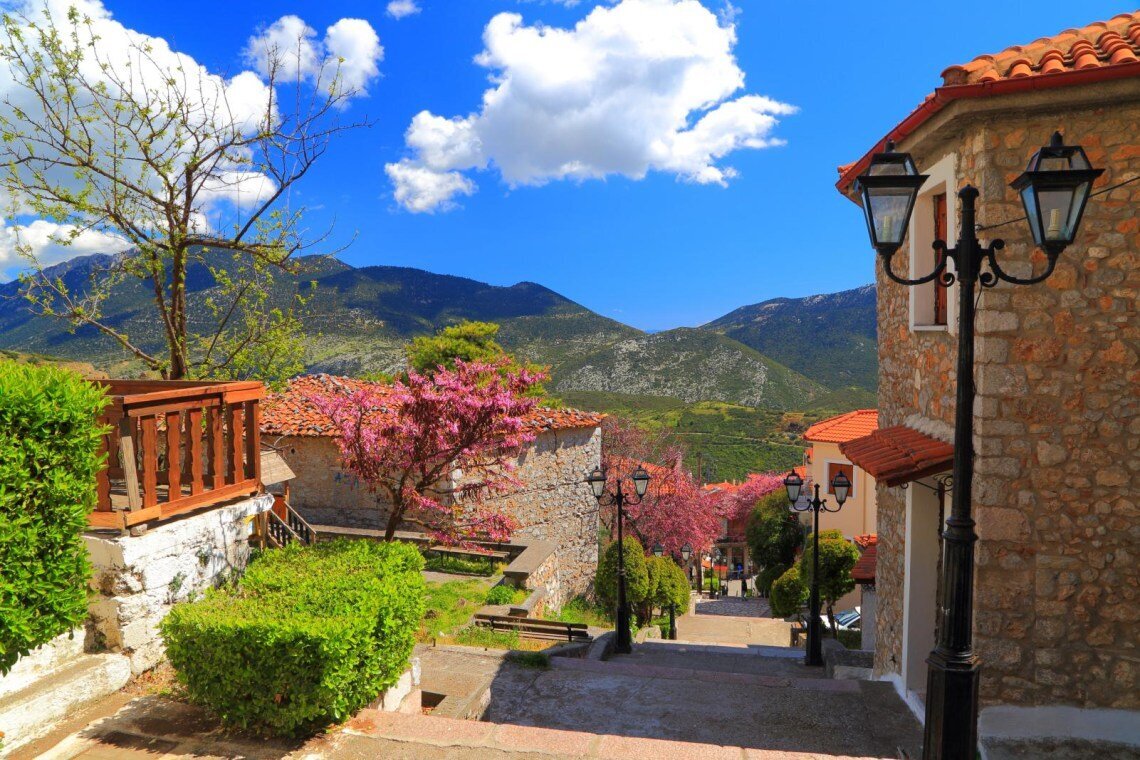
A day trip to Delphi from Athens takes you to the ancient sanctuary of Apollo, once considered the center of the world in Greek mythology. Most day trip to Delphi from Athens tours depart early morning and include the archaeological site, the Temple of Apollo, the ancient theater, and the Delphi Archaeological Museum housing the Charioteer statue. The scenic drive through Central Greece passes mountain villages and offers views of the Corinthian Gulf and Mount Parnassus.
The sanctuary at Delphi functioned as the spiritual center of the ancient Greek world for over a millennium, its Oracle consulted by kings, generals, and city-states before every major decision. Priestesses inhaled vapors rising from a chasm in the earth and delivered cryptic prophecies attributed to Apollo himself.
The site's wealth grew immense — treasuries built by rival cities lined the Sacred Way, each structure competing to display offerings in gold, bronze, and marble. By the fourth century BCE, Delphi controlled vast temple lands and hosted the Pythian Games, second only to Olympia in prestige.
Today the archaeological zone spreads across the southern slopes of Mount Parnassus, 600 meters above the Pleistos valley. The Temple of Apollo stands at the heart of the complex, its surviving columns marking where the Oracle delivered her pronouncements. Above it, the ancient theater seats 5,000 and offers views across olive groves to the Gulf of Corinth. Higher still, the stadium hosted foot races and chariot competitions, its limestone tiers remarkably intact. Day trip to Delphi from Athens excursions typically allocate three hours for the hillside ruins and another hour for the on-site museum.
The Delphi Archaeological Museum houses bronze charioteers, stone sphinxes, and the twin kouroi known as Kleobis and Biton — sixth-century sculptures that defined the archaic Greek style. The Treasury of the Siphnians frieze depicts mythological battles in precise relief. Roman-era statues of emperors and philosophers fill the final galleries, evidence of Delphi's continued importance through the imperial period. One day tours to Delphi from Athens often pair the sanctuary with a stop at the Monastery of Hosios Loukas or the mountain village of Arachova, depending on routing and season.
The site closes at 19:30 in summer months, with last entry 30 minutes prior. Morning arrivals between 08:30 and 10:30 avoid the midday tour bus waves and the exposed hillside heat. The combined ticket grants access to both the outdoor ruins and the museum. Private day trip to Delphi from Athens options provide flexible schedules and dedicated transport, while half-day trip to Delphi from Athens variants compress the visit into a morning departure and afternoon return.

Priestesses inhaled vapors rising from a chasm in the earth and delivered cryptic prophecies attributed to Apollo himself.
Wear flat, closed-toe shoes with good grip since the paths up to the Temple of Apollo and the Ancient Theatre of Delphi are steep, uneven marble. Light, breathable clothing works for most of the year, but bring a layer for the exposed hillside, which can be windy even when Athens is warm.
Bag checks operate at the entrance gate near the ticket office, and backpacks are allowed but large suitcases or bulky luggage are not permitted inside the site or museum. Staff may ask to inspect bags before you pass through the turnstiles leading to the Sacred Way.
Personal photography without flash is permitted throughout the outdoor archaeological site, including at the Temple of Apollo and Stadium of Delphi. Inside the Delphi Archaeological Museum, tripods and flash photography are restricted near the Charioteer of Delphi and other fragile bronze and marble exhibits.
Children generally handle the walk to the Temple of Apollo well, though strollers struggle on the gravel and marble sections above the museum. There are no dedicated play areas, so plan for a slow, supervised walk given the drop-offs along some retaining walls.
The lower section near the museum is relatively flat, but the path up to the Temple of Apollo, the Ancient Theatre, and the Stadium involves loose gravel, marble steps, and a steady incline with no ramps. Wheelchair and limited-mobility access is difficult on the upper terraces, and the museum offers easier level access than the open-air ruins.
No food or drink other than bottled water is allowed inside the archaeological site or the museum galleries. Picnicking is not permitted on the ruins themselves, and any packed snacks must be consumed outside the ticketed area.
Tour buses arrive early
Hours
08:00–19:30 daily, last entry ~30 min before close
Opening hours
08:00 – 19:30
Getting there
City-center access via metro and bus
Accessibility
Most experiences are wheelchair-friendly — check individual tours
What to bring
Comfortable shoes, water, phone for mobile voucher
Car · 2.5–3h · Tolls plus fuel, roughly 20–25 EUR each way
Drive via the A1 and E75 motorways from Athens through Thebes and Livadeia, then the mountain road into Delphi
Combined tickets (12 EUR, covering the archaeological site and museum) purchased directly at the gate are non-refundable. Tours and skip-the-line day trip to Delphi from Athens tickets booked through operators typically allow free cancellation up to 24–48 hours before departure, subject to the operator's own terms.
Recommended time
3-4 hours
Budget 3 to 4 hours to cover both the archaeological site and the museum without rushing: roughly 2 hours on the hillside among the temple terraces and theater, then 45-60 minutes in the museum for the bronze Charioteer and other finds. Arriving inside the 08:30-10:30 window keeps queues at the ticket booth minimal and gives you the paths before tour coaches from Athens unload mid-morning. A day trip to delphi from athens built around an early departure lets you finish on-site by early afternoon, which suits a half day itinerary; add an extra hour if you want a slower museum pass or plan to linger over the Tholos view. By 11:30 the site fills in noticeably, so subtract time rather than add it if you arrive later.
Crowd levels through the day
Weather · crowds · average price — dots go green to amber to red as each metric rises.
Wildflowers cover the hillside and temperatures sit around 15–20°C, making the climb to the Temple of Apollo comfortable. Crowds build toward late May as school groups increase.
The paths to the Temple of Apollo and Stadium are steep, uneven marble and gravel, so trainers or hiking shoes work far better than sandals.
Archaeological Site of Delphi, Delphi 330 54, Greece
Group tour buses typically gather here before entry
Get directionsThe sanctuary at Delphi emerged in the eighth century BCE when Greeks began worshipping Apollo on the slopes of Mount Parnassus, though mythology claimed the god slew the serpent Python to claim the site. By 590 BCE the Oracle of Delphi—a priestess called the Pythia who delivered prophecies while seated on a tripod over a chasm—held such authority that city-states consulted her before founding colonies, declaring war, or enacting laws. Kings traveled from Lydia and Egypt to ask questions; Croesus of Lydia famously misinterpreted her response and lost his kingdom to Persia in 546 BCE. The first stone Temple of Apollo rose around 650 BCE, burned in 548 BCE, and was rebuilt with funds from across the Greek world, including a controversial donation from the Alcmaeonid family exiled from Athens. The Amphictyonic League, a coalition of Greek states, controlled the sanctuary and waged the Sacred Wars in 595 BCE and 356 BCE to defend its autonomy. Delphi's treasury houses, built by rival city-states to store offerings, turned the hillside into a marble showcase of competitive piety. The site lost influence after Rome conquered Greece in 146 BCE, though emperors including Nero still visited. Emperor Theodosius I banned pagan rites in 393 CE, silencing the Oracle after a thousand years. Earthquakes and landslides buried the ruins under soil and a village called Kastri. French archaeologists began excavating in 1892 after the Greek government relocated Kastri's residents, uncovering the Temple of Apollo, the theater, the stadium, and thousands of inscriptions. Today a day trip to delphi from athens reveals the stone seats where pilgrims waited, the Sacred Way lined with treasury foundations, and the museum holding the Charioteer of Delphi, a bronze masterpiece from 478 BCE. Those planning day trip to delphi from athens tours walk the same processional route ancient Greeks followed to consult the god. The polygonal wall supporting the temple terrace still bears the manumission inscriptions that freed slaves under Apollo's witness.
Worship of Apollo begins at Delphi, establishing the site as a sacred precinct.
The Oracle of Delphi reaches peak influence, consulted by city-states across the Mediterranean on matters of war and colonization.
Fire destroys the first stone Temple of Apollo; reconstruction funded by contributions from Greek cities and foreign rulers.
The Third Sacred War erupts when Phocis seizes Delphi; Philip II of Macedon intervenes and gains control of the Amphictyonic League.
Emperor Theodosius I bans pagan worship, ending the Oracle's operation after more than a millennium.
French archaeologists begin systematic excavation after relocating the village of Kastri, uncovering the temple, theater, and stadium.
The six restored Doric columns on the temple's east side are the site's signature shot, framed against Mount Parnassus. Stand on the path just below the terrace for a clean upward angle, or climb slightly higher for a wider frame with the valley behind. This spot alone justifies a day trip to Delphi from Athens for most visitors with a camera.
From the top rows of the theatre's stone seating, the view stretches over the temple ruins down to the olive-covered valley and the Gulf of Corinth in the distance. Sit or stand at the highest tier for the full sweep. Wide-angle lenses capture both the amphitheatre curve and the landscape beyond.
The zigzagging path lined with the bases of votive monuments and treasury ruins offers a strong leading-line composition as it climbs the hillside. Shoot from a lower bend looking upward toward the temple terrace. The stonework and cypress trees add texture on either side.
At the summit of the site, the stadium's surviving stone starting blocks and partial seating rows sit in a flat grassy clearing framed by pine-covered slopes. Stand near the entrance arch for a symmetrical view down the track. It is quieter than the lower terraces, with fewer people in frame.
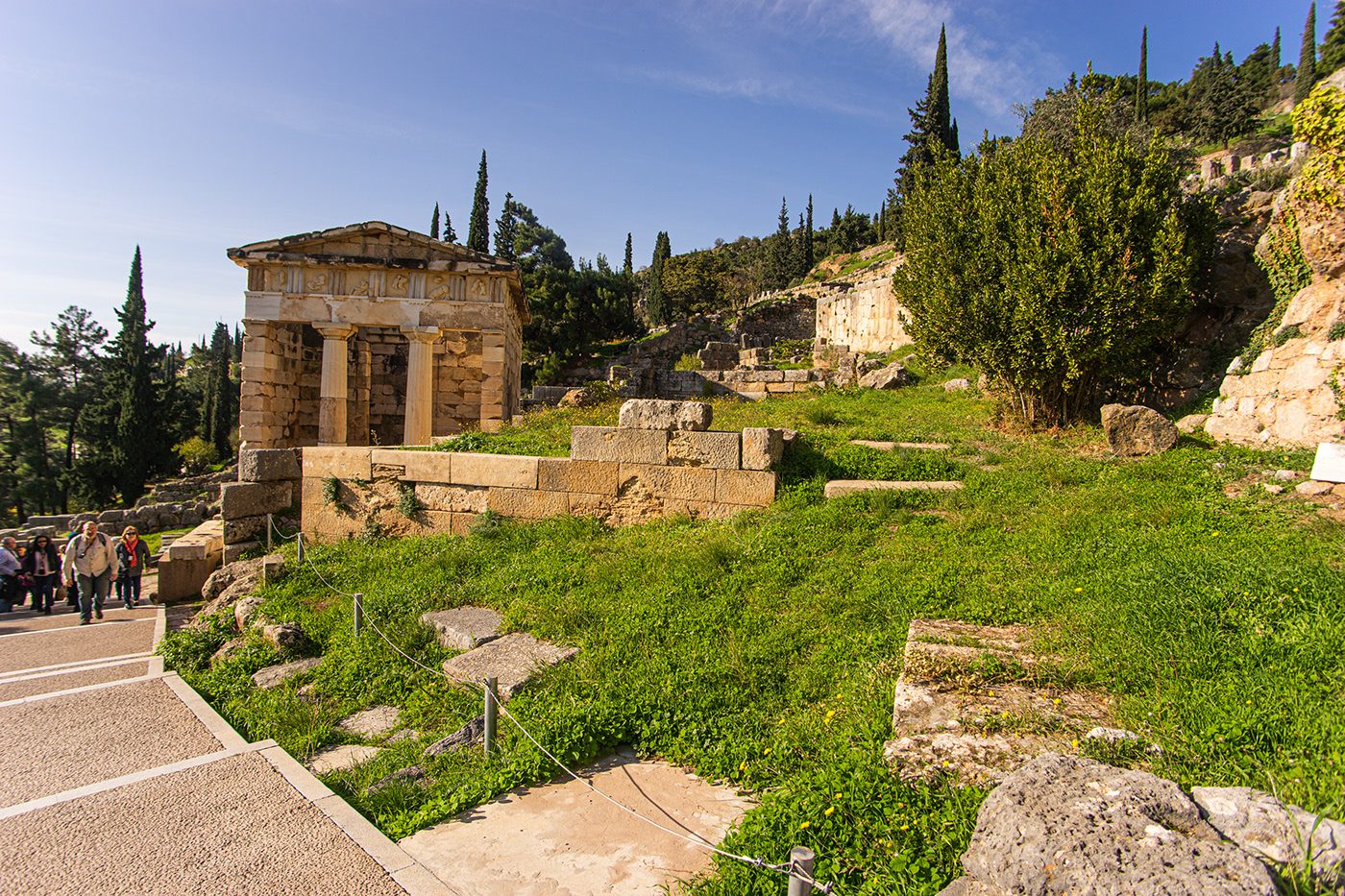
This compact, partly reconstructed building along the Sacred Way is one of the best-preserved structures on site and photographs well head-on or at a three-quarter angle. Its pale stone contrasts sharply with the darker hillside rock behind it.
A short walk from the main site, the circular Tholos with its three standing columns is one of the most photographed ruins in Greece, set against terraced olive groves. Shoot from the path above for the classic elevated angle.
Most people planning a day trip to delphi from athens save lunch for the village of Delphi itself, a short drive from the ruins, where a strip of tavernas along Vasileos Pavlou and Frideriki serves grilled meats and mezedes with sweeping views over the valley toward Itea. There's nothing to eat inside the archaeological site, so this walkable row of family-run spots is where the tour buses empty out around midday.
Long-running family taverna known for oven-baked lamb and wild greens, with a terrace overlooking the olive valley; fills up fast once the midday tour groups arrive, so an early or late lunch is easier to time.
Traditional Greek dishes and grilled meats served on a view terrace in the village center, popular with guided groups, so expect a wait between 13:00 and 15:00.
Family-style spot for slow-cooked stews and grilled meat, quieter than the bigger terraces and a good option if you want a sit-down meal without the tour-bus crush.
Quick counter for pies, sandwiches and coffee, suited to a fast bite before or after the site rather than a full meal.
Real experiences from real travelers
Our day trip to Delphi from Athens exceeded expectations. The Temple of Apollo site felt genuinely sacred standing among those ancient columns with the valley spread below. Our guide explained the Oracle's chamber location and the Pythian Games history. The museum's Charioteer statue alone justified the visit.
Took a guided excursion from Athens and found Delphi remarkably intact for a 2,600-year-old site. The Tholos rotunda at Athena Pronaia made for perfect photos in morning light. Stadium seating offered shade and valley views during our lunch break. Pack water—limited facilities between zones.
The archaeological complex sits at an elevation that keeps temperatures comfortable even in June. Treasury of the Athenians reconstruction shows original scale. We spent nearly four hours exploring terraces and reading site markers. A day trip to Delphi from Athens tours typically allocate three hours onsite which felt adequate.
The sanctuary layout became clear once our guide traced the Sacred Way uphill past treasury foundations. Museum context helped—seeing the twin Kouroi statues and understanding their votive purpose added depth. Afternoon crowds near the temple grew dense. Arrive early if taking day trip to Delphi from Athens tickets.
What distinguishes this ancient site is the mountain setting. Standing in the theater looking down at the temple ruins with the valley beyond creates perspective no coastal site matches. The omphalos stone replica marks where ancient Greeks believed the world's center existed. Solid half-day from Athens.
Many visitors rush through the Delphi Archaeological Museum but the Sphinx of Naxos and frieze fragments deserve time. The bronze Charioteer's preserved inlaid eyes seem to track you. Site itself requires moderate fitness—uneven stone paths and elevation changes. Our Athens departure returned us by 7 PM.
Booked a small group tour for this Delphi excursion and the guide's classical education background made myths tangible. The polygonal wall's interlocking stones have survived earthquakes for 2,400 years. Theater acoustics still function—whispers from the stage carried to upper rows where we sat.
The adyton chamber beneath the temple where the Pythia delivered prophecies exists only as foundation outline now but the setting communicates ancient power. Treasury inscriptions and athlete dedications throughout the Sacred Way show Delphi's pan-Hellenic importance. Took the early direct coach from Athens.
As someone who visits many ancient sites, Delphi's concentration of well-labeled remains impressed. The gymnasium complex below the main sanctuary rarely appears in photos but shows Olympic training facilities. Spring wildflowers covered the slopes during our visit. Standard day trip to Delphi from Athens transport takes roughly 2.5 hours each direction.
Understanding that city-states sent delegations here for prophecies before major decisions gives the treasury buildings new meaning. Each structure represented a different polis showing wealth and piety. The site's UNESCO status ensures ongoing conservation. Cool mountain air at this elevation provided relief from Athens heat.
Everything you need to know for your journey
The archaeological site and museum are open daily from 08:00 to 19:30, with last entry roughly 30 minutes before closing.
The combined ticket covering both the archaeological site and museum costs 12 EUR per person.
The museum's lower level is fairly level, but the paths up to the Temple of Apollo, Ancient Theatre, and Stadium involve steep, uneven marble with no ramps.
Small daypacks and bottles of water are fine, but large suitcases, tripods for museum use, drones, and glass containers are not permitted.
Photography without flash is allowed outdoors across the site, while the museum restricts flash and tripods near fragile pieces like the Charioteer of Delphi.
Arriving between 08:30 and 10:30 avoids most tour buses and the midday heat on the exposed hillside, making it the best window for a day trip to Delphi from Athens.
There's no strict dress code, but closed-toe shoes are strongly recommended given the steep, uneven terrain around the Sacred Way.
Food and drink other than bottled water are not allowed inside the site or museum, so plan any picnic for outside the ticketed area.
KTEL buses depart from the Liosion 260 terminal in Athens several times a day and take about three hours to reach Delphi.
Older children generally manage the walking well, though the terrain and drop-offs mean close supervision is needed, and strollers struggle on the gravel paths.
Tickets bought directly at the gate are non-refundable, while many day trip to Delphi from Athens tours booked through operators allow free cancellation 24–48 hours ahead.
The Castalian Spring, the Gymnasium of Delphi, and the Sanctuary of Athena Pronaia with its Tholos are all within a short walk or drive of the main sanctuary.
Houses the Charioteer of Delphi bronze and finds from the Sanctuary of Apollo excavations.
Small hotels and guesthouses line the main street with views over the Pleistos Valley.
Join thousands of happy travelers who have discovered this incredible experience
Book Your Experience Now